Green HRM Practices: Exploring Awareness and Adoption across Demographic Groups
DOI:
https://doi.org/10.5281/zenodo.18073418Keywords:
G-HRM practices, awareness, adoption levelAbstract
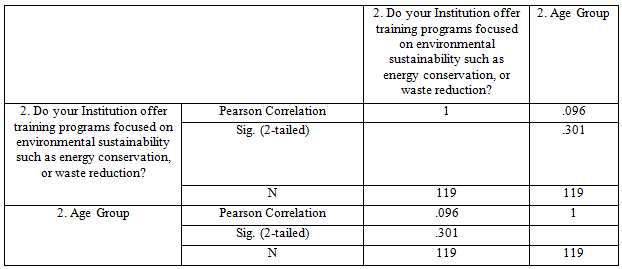
Green Human Resource Management (Green HRM) refers to the integration of eco-friendly practices and policies within human resource management to enhance organizational sustainability. It incorporated environmental considerations into key HR functions, such as recruitment, training, performance evaluation, and employee engagement. Green HRM initiatives aimed to reduce paper usage, conserve energy, minimize waste, and cultivate a workplace culture that prioritized sustainability. This study primarily focused on evaluating the awareness and adoption levels of Green HRM practices among individuals with varying demographic characteristics, including age, gender, and education. Data were collected using a primary survey method, and correlation and regression analyses were conducted using SPSS to derive insights. The findings revealed that individuals with higher educational qualifications tended to adopt Green HRM practices but often lacked awareness of the concept. Conversely, individuals within the primary age group demonstrated both awareness and adoption of these practices.
Downloads
References
Amjad, F., Abbas, W., Zia-UR-Rehman, M., Baig, S. A., Hashim, M., Khan, A., & Rehman, H. ur. (2021). Effect of green human resource management practices on organizational sustainability: the mediating role of environmental and employee performance. Environmental Science and Pollution Research, 28(22), 28191–28206. https://doi.org/10.1007/s11356-020-11307-9
Arora, M., & Kaul, A. (2020). Green human resource management: An empirical study of India. Visegrad Journal on Bioeconomy and Sustainable Development, 9(2), 61–66. https://doi.org/10.2478/vjbsd-2020-0012
George, A., Swarnakar, C., Manna, T., & Pujari, M. (2022). Awareness of green HRM in Indian organizations. International Journal of Innovative Science and Research Technology, 7(6), 1680.
Hmeedat, O., & Albdareen, R. (2022). The impact of green human resources management practices on the relationship between commitment to social responsibility and sustainable performance. Information Sciences Letters, 11(4), 1013–1022. https://doi.org/10.18576/isl/110402
Malik, S. Y., Cao, Y., Mughal, Y. H., Kundi, G. M., Mughal, M. H., & Ramayah, T. (2020). Pathways towards sustainability in organizations: Empirical evidence on the role of green human resource management practices and green intellectual capital. Sustainability (Switzerland), 12(8). https://doi.org/10.3390/SU12083228
Raut, R. D., Gardas, B., Luthra, S., Narkhede, B., & Kumar Mangla, S. (2020). Analysing green human resource management indicators of automotive service sector. International Journal of Manpower, 41(7), 925–944. https://doi.org/10.1108/IJM-09-2019-0435
Salim, A., Gogoi, N., & Dutta, S. (2022). Greening the workplace: A study of green HRM practices adopted by Indian corporates.
Sujata Das, & Madhusmita Dash. (2023). Green HRM -Need of the hour for environmental sustainability. International Journal of Reviews and Research in Social Sciences, 11(2):65-1. doi: 10.52711/2454-2687.2023.00011
Yadav, M. (2023.). A study of employees perception and awareness towards green HRM practices and contemporary green HRM practices at selected automobile industries in Pune district. https://doi.org/10.13140/RG.2.2.14082.08643
Published
How to Cite
Issue
Section
License
Copyright (c) 2025 Rishita Mohanty, Jayashree Jethy, Sweeta Agrawal

This work is licensed under a Creative Commons Attribution 4.0 International License.
Research Articles in 'Management Journal for Advanced Research' are Open Access articles published under the Creative Commons CC BY License Creative Commons Attribution 4.0 International License http://creativecommons.org/licenses/by/4.0/. This license allows you to share – copy and redistribute the material in any medium or format. Adapt – remix, transform, and build upon the material for any purpose, even commercially.


