From D2C to Omnichannel: An Empirical Study of Growth, Profitability and Financial Sustainability of Selected Indian Consumer Brands
DOI:
https://doi.org/10.54741/MJAR/6.5.2026.337Keywords:
D2C, e-commerce, omnichannel retail, profitability, financial sustainability, digital commerce, indian consumer brands, compound annual growth rate (CAGR), earnings before interest, taxes, depreciation and amortisation (EBITDA)Abstract
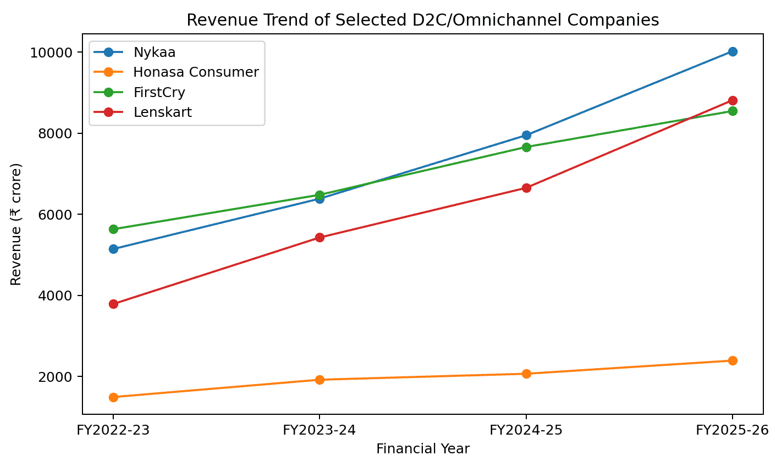
The rapid expansion of direct-to-consumer (D2C) businesses has transformed the Indian retail environment by enabling brands to reach consumers directly through digital channels. However, revenue growth alone does not establish financial sustainability. Increasing expenditure on marketing, technology, fulfilment and physical expansion has encouraged several digital-first businesses to adopt omnichannel strategies. The present study examines the growth, profitability and selected indicators of financial sustainability of four prominent Indian digital-first and omnichannel consumer businesses: Nykaa, Honasa Consumer, FirstCry and Lenskart—during FY2022-23 to FY2025-26. The study uses consolidated secondary financial data and applies simple descriptive techniques comprising revenue growth, Compound Annual Growth Rate (CAGR), Earnings Before Interest, Taxes, Depreciation and Amortisation (EBITDA) margin, net profit margin, mean, standard deviation, coefficient of variation and comparative ranking. No complex econometric technique is employed. The results indicate that all four companies achieved substantial revenue expansion, but the conversion of growth into profitability differed markedly. Lenskart recorded the highest revenue CAGR and the strongest average EBITDA and PAT margins, while Nykaa showed consistent revenue growth and steadily improving profitability. Honasa Consumer displayed a temporary decline in profitability followed by a strong recovery in FY2025-26. FirstCry improved its EBITDA margin and reduced its consolidated losses, but remained loss-making throughout the study period. The findings suggest that D2C growth becomes financially sustainable only when scale is accompanied by improving operating margins and the ability to reduce or eliminate losses.
Downloads
References
Beck, N., & Rygl, D. (2015). Categorization of multiple channel retailing in multi-, cross-, and omni-channel retailing for retailers and retailing. Journal of Retailing and Consumer Services, 27, 170–178. https://doi.org/10.1016/j.jretconser.2015.08.001
Cao, L., & Li, L. (2015). The impact of cross-channel integration on retailers' sales growth. Journal of Retailing, 91(2), 198–216. https://doi.org/10.1016/j.jretai.2014.12.005
Gallino, S., & Moreno, A. (2014). Integration of online and offline channels in retail: The impact of sharing reliable inventory availability information. Management Science, 60(6), 1434–1451. https://doi.org/10.1287/mnsc.2014.1951
Grewal, D., Roggeveen, A. L., & Nordfält, J. (2017). The future of retailing. Journal of Retailing, 93(1), 1–6. https://doi.org/10.1016/j.jretai.2016.12.008
Herhausen, D., Binder, J., Schoegel, M., & Herrmann, A. (2015). Integrating bricks with clicks: Retailer-level and channel-level outcomes of online-offline channel integration. Journal of Retailing, 91(2), 309–325. https://doi.org/10.1016/j.jretai.2014.12.009
Hübner, A., Holzapfel, A., & Kuhn, H. (2016). Distribution systems in omni-channel retailing. Business Research, 9, 255–296. https://doi.org/10.1007/s40685-016-0034-7
Juaneda-Ayensa, E., Mosquera, A., & Sierra Murillo, Y. (2016). Omnichannel customer behavior: Key drivers of technology acceptance and use and their effects on purchase intention. Frontiers in Psychology, 7, Article 1117. https://doi.org/10.3389/fpsyg.2016.01117
Lemon, K. N., & Verhoef, P. C. (2016). Understanding customer experience throughout the customer journey. Journal of Marketing, 80(6), 69–96. https://doi.org/10.1509/jm.15.0420
McKee, S., Sands, S., Pallant, J. I., & Cohen, J. (2023). The evolving direct-to-consumer retail model: A review and research agenda. International Journal of Consumer Studies, 47(6), 2816–2842. https://doi.org/10.1111/ijcs.12972
Pauwels, K., & Neslin, S. A. (2015). Building with bricks and mortar: The revenue impact of opening physical stores in a multichannel environment. Journal of Retailing, 91(2), 182–197. https://doi.org/10.1016/j.jretai.2015.02.001
Piotrowicz, W., & Cuthbertson, R. (2014). Introduction to the special issue information technology in retail: Toward omnichannel retailing. International Journal of Electronic Commerce, 18(4), 5–16. https://doi.org/10.2753/JEC1086-4415180400
Sorescu, A., Frambach, R. T., Singh, J., Rangaswamy, A., & Bridges, C. (2011). Innovations in retail business models. Journal of Retailing, 87(Supplement 1), S3–S16. https://doi.org/10.1016/j.jretai.2011.04.005
Verhoef, P. C., Kannan, P. K., & Inman, J. J. (2015). From multi-channel retailing to omni-channel retailing: Introduction to the special issue on multi-channel retailing. Journal of Retailing, 91(2), 174–181. https://doi.org/10.1016/j.jretai.2015.02.005
Wollenburg, J., Holzapfel, A., & Hübner, A. (2019). Omni-channel customer management processes in retail: An exploratory study on fulfillment-related options. Logistics Research, 12, Article 7. https://doi.org/10.23773/2019_7
Penman, S. H. (2013). Financial statement analysis and security valuation. (5th ed.). McGraw-Hill Education.
Subramanyam, K. R. (2014). Financial statement analysis. (11th ed.). McGraw-Hill Education.
Brainbees Solutions Limited. (2023–2026). Annual reports and consolidated financial statements, FY2022–23 to FY2025–26. Company Investor Relations and Stock Exchange Disclosures.
FSN E-Commerce Ventures Limited. (2023–2026). Annual reports and consolidated financial statements, FY2022–23 to FY2025–26. Company Investor Relations and Stock Exchange Disclosures.
Honasa Consumer Limited. (2023–2026). Annual reports and consolidated financial statements, FY2022–23 to FY2025–26. Company Investor Relations and Stock Exchange Disclosures.
Lenskart Solutions Limited. (2023–2026). Annual reports and consolidated financial statements, FY2022–23 to FY2025–26. Company Investor Relations and Stock Exchange Disclosures.
Published
How to Cite
Issue
Section
License
Copyright (c) 2026 Mahasweta Chakraborty, Sangita Sen, Ashirbani Bardhan

This work is licensed under a Creative Commons Attribution 4.0 International License.
Research Articles in 'Management Journal for Advanced Research' are Open Access articles published under the Creative Commons CC BY License Creative Commons Attribution 4.0 International License http://creativecommons.org/licenses/by/4.0/. This license allows you to share – copy and redistribute the material in any medium or format. Adapt – remix, transform, and build upon the material for any purpose, even commercially.


