Algorithmic Dependence in AI-Driven Investment Decisions among Indian Advisors
DOI:
https://doi.org/10.54741/MJAR/6.5.2026.331Keywords:
algorithmic dependence, decision effectiveness, indian advisors, investor confidence, perceived accuracy, risk-taking behaviourAbstract
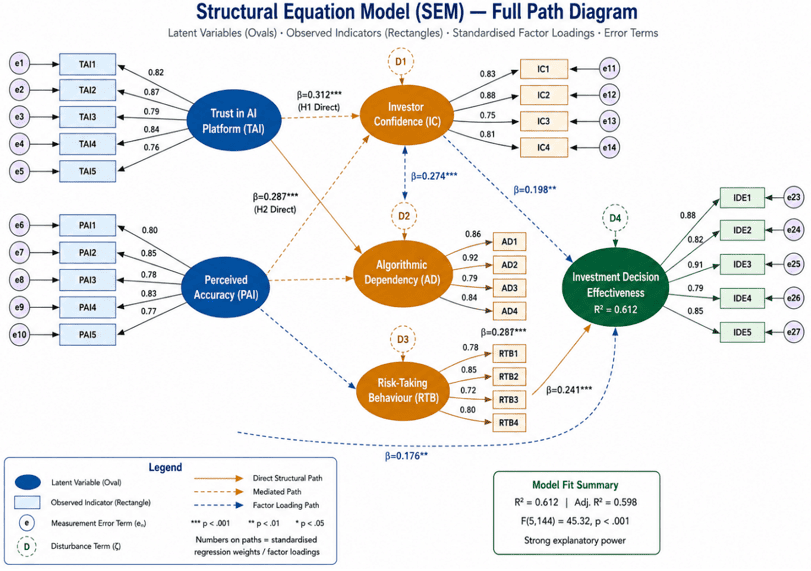
India is witnessing a tremendous change in the pattern of investment behaviour due to the intervention of Artificial Intelligence in driving the advisory behaviour and ultimately affecting the decision-making among the investors/advisors. The study attempts to examine the algorithmic dependent advisory behaviour of portfolio managers/advisors in applying AI tools for investment decision-making over their personal judgement to time the market. The study is administered through structured questionnaire on 150 portfolio managers/investment advisors across Inda. The research indicates that investor advisors rely majorly on the AI-driven platforms for investment recommendations to their retail clientele. They strongly agree to follow the recommendations offered by the AI platforms. The respondents agree that their confidence is increasing in market predictions and they strongly believe that AI driven market predictions are better than their judgements on investment decisions. AI-driven algorithmic advisory indeed has developed and enhanced the performance confidence among the advisors but excessive dependence on algorithmic advisory can be alarming as it shall impact the habit of independent critical thinking. The paper attempts to contribute to the growing domain of behavioural finance in India and attempts to invite further research to investigate the rising and changing behaviours in investment and advisory due to AI interventions.
Downloads
References
Barber, B. M., & Odean, T. (2001). Boys will be boys: Gender, overconfidence, and common stock investment. The Quarterly Journal of Economics, 116(1), 261-292.
Baron, R. M., & Kenny, D. A. (1986). The moderator-mediator variable distinction in social psychological research. Journal of Personality and Social Psychology, 51(6), 1173-1182.
Cheng, X., & Jiang, Y. (2021). Explainability and trust in AI-based financial advisory: Evidence from retail investors in Asian markets. Journal of Financial Technology, 3(2), 89-112.
Davis, F. D. (1989). Perceived usefulness, perceived ease of use, and user acceptance of information technology. MIS Quarterly, 13(3), 319-340.
Gefen, D., Karahanna, E., & Straub, D. W. (2003). Trust and TAM in online shopping: An integrated model. MIS Quarterly, 27(1), 51-90.
Graham, J. R., Harvey, C. R., & Huang, H. (2009). Investor competence, trading frequency, and home bias. Management Science, 55(7), 1094-1106.
Hair, J. F., Black, W. C., Babin, B. J., & Anderson, R. E. (2019). Multivariate data analysis. (8th ed.). Cengage Learning.
Hendershott, T., Jones, C. M., & Menkveld, A. J. (2011). Does algorithmic trading improve liquidity?. The Journal of Finance, 66(1), 1-33.
Kahneman, D., & Tversky, A. (1979). Prospect theory: An analysis of decision under risk, Econometrica, 47(2), 263-291.
Lee, J. D., & See, K. A. (2004). Trust in automation: Designing for appropriate reliance. Human Factors, 46(1), 50-80.
Logg, J. M., Minson, J. A., & Moore, D. A. (2019). Algorithm appreciation: People prefer algorithmic to human judgment. Organizational Behavior and Human Decision Processes, 151, 90-103.
Lusardi, A., & Mitchell, O. S. (2014). The economic importance of financial literacy: Theory and evidence. Journal of Economic Literature, 52(1), 5-44.
McKnight, D. H., Choudhury, V., & Kacmar, C. (2002). Developing and validating trust measures for e-commerce. Information Systems Research, 13(3), 334-359.
Mehrotra, A., & Agarwal, S. (2020). Digital financial services and retail investor participation in post-demonetisation India. Indian Journal of Finance and Economics, 12(3), 45-63.
Nunnally, J. C. (1978). Psychometric theory. (2nd ed.). McGraw-Hill.
Parasuraman, R. (2000). Designing automation for human use: Empirical studies and quantitative models. Ergonomics, 43(7), 931-951.
Payne, J. W., Bettman, J. R., & Johnson, E. J. (1993). The adaptive decision maker. Cambridge University Press.
Weber, E. U., Blais, A. R., & Betz, N. E. (2002). A domain-specific risk-attitude scale: Measuring risk perceptions and risk behaviors. Journal of Behavioral Decision Making, 15(4), 263-290.
Published
How to Cite
Issue
Section
License
Copyright (c) 2026 Pooja Gupta, Shreyansh Khare, Samkit Pareta

This work is licensed under a Creative Commons Attribution 4.0 International License.
Research Articles in 'Management Journal for Advanced Research' are Open Access articles published under the Creative Commons CC BY License Creative Commons Attribution 4.0 International License http://creativecommons.org/licenses/by/4.0/. This license allows you to share – copy and redistribute the material in any medium or format. Adapt – remix, transform, and build upon the material for any purpose, even commercially.


