Firm-Size, Profitability, Leverage and Earnings Management of Indian Healthcare Companies
DOI:
https://doi.org/10.54741/MJAR/6.4.2026.327Keywords:
earnings management, modified jones model, firm size, profitability, leverage, indian healthcare firmsAbstract
This study examines the relationship between the firm size and earnings management in selected Indian Healthcare firms listed in BSE Healthcare Index. The firm size is measured using natural logarithm of total assets. Here, Discretionary Accruals (DACC) is used as a proxy for earnings management, along with absolute discretionary accruals (abs_DACC) to capture the magnitude of manipulation among Indian healthcare firms. The study uses a combination of descriptive statistics, correlation analysis along with panel data regression methods, including fixed and random-effects regression models with Hausman test (Hausman, J. A.,1978) to choose the appropriate model between them. The Hausman test indicates that the fixed-effects model is more appropriate for estimation.
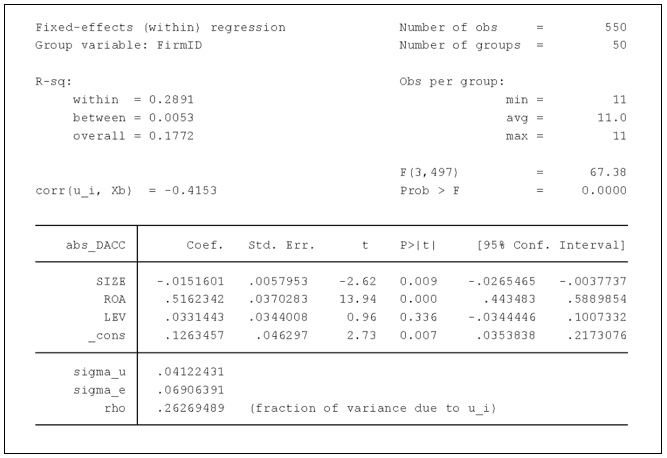
ANOVA is used to investigate differences in earnings management across firms’ various sizes (Large-cap, mid-cap and small-cap firms). The results show that firm size has a significant negative relationship with earnings management (EM), implying that large healthcare enterprises indulge in lower levels of earnings management practices. Profitability indicates a positive association with earnings management. Leverage is found to be insignificant. The ANOVA results indicate that earnings management significantly differs across firm sizes, with small firms demonstrating highest level of earnings manipulation, implying larger firms are governed and scrutinized more closely which discourages opportunistic reporting practices.
Downloads
References
Hausman, J. A. (1978). Specification tests in econometrics. Econometrica, 46(6), 1251–1271
Adhikary, B. K., Mitra, R. K., & Meah, M. R. (2021). Do manufacturing firms in Bangladesh engage in earnings management to avoid losses? Further evidence using the governance elements as monitors. Journal of Financial Reporting and Accounting, 19(5), 839–860.
Ajit, D., Malik, S., & Verma, V. K. (2013). Earnings management in India (SEBI development research group study no. 2). Securities and Exchange Board of India.
Alzoubi, E. S. S. (2016). Audit quality and earnings management: Evidence from Jordan. Journal of Applied Accounting Research, 17(2), 170-189
Bassiouny, S. W. (2016). The impact of firm characteristics on earnings management: An empirical study on the listed firms in Egypt. Journal of Business and Retail Management Research, 10(3), 34-45.
Burgstahler, D., & Dichev, I. (1997). Earnings management to avoid earnings decreases and losses. Journal of Accounting and Economics, 24(1), 99-126.
DeAngelo, L. E. (1986). Accounting numbers as market valuation substitutes: A study of management buyouts of public stockholders. The Accounting Review, 61(3), 400–420.
Dechow, P. M., Sloan, R. G., & Sweeney, A. P. (1995). Detecting earnings management. The Accounting Review, 70(2), 193–225.
Degeorge, F., Patel, J., & Zeck Hauser, R. (1999). Earnings management to exceed thresholds. The Journal of Business, 72(1), 1-33
García-Teruel, P. J., Martínez-Solano, P., & Sánchez-Ballesta, J. P. (2014). The role of accruals quality in the access to bank debt. Journal of Banking & Finance, 38, 186-193.
Githaiga, P. N., Mugo, R., & Gakenia, C. (2022). Board characteristics and earnings management: Does firm size matter?. Cogent Business & Management, 9(1), Article 2088573.
Habib, A., Uddin Bhuiyan, B., & Islam, A. (2013). Financial distress, earnings management and market pricing of accruals during the global financial crisis. Managerial Finance, 39(2), 155–180.
Healy, P. M. (1985). The effect of bonus schemes on accounting decisions. Journal of Accounting and Economics, 7(1–3), 85–107. https://doi.org/10.1016/0165-4101(85)90029-1
Hoang, K. M. T., & Phung, T. A. (2019). The effect of financial leverage on real and accrual-based earnings management in Vietnamese firms. Economics & Sociology, 12(4), 299–312.
Jones, J. J. (1991). Earnings management during import relief investigations. Journal of Accounting Research, 29(2), 193–228.
Kothari, S. P., Leone, A. J., & Wasley, C. E. (2005). Performance matched discretionary accrual measures. Journal of Accounting and Economics, 39(1), 163–197.
Kurniawati, A., & Panggabean, R. R. (2020). Firm size, financial distress, audit quality, and earnings management of banking companies. in Proceedings of the 1st Borobudur International Symposium on Humanities, Economics and Social Sciences (BIS-HESS 2019), pp. 413–417. Atlantis Press.
Lazzem, S., & Jilani, F. (2018). The impact of leverage on accrual-based earnings management: The case of listed French firms. Research in International Business and Finance, 44, 350–358.
Mangala, D., & Dhanda, S. (2022). Earnings management in Indian IPOs. Business Perspectives and Research. Advance online publication. https://doi.org/10.1177/22785337221090445
Miller, G. S. (2002). Earnings performance and discretionary disclosure. Journal of Accounting Research, 40(1), 173–204.
Mlawu, L., Mokoaleli-Mokoteli, T., & Khumalo, J. (2025). Incentives for accrual-based earnings management in developing countries: A systematic review. Administrative Sciences, 15(6), Article 209.
Shoaib, A., & Siddiqui, M. A. (2022). Earnings management and theoretical adjustment in capital structure performance: Evidence from Pakistan. Borsa Istanbul Review, 22(Suppl. 1), S1–S13.
Tiwari, S. (2024). Effect of earnings management on readability of MDA in Indian firms. IIMB Management Review.
Watts, R. L., & Zimmerman, J. L. (1986). Positive accounting theory. Prentice-Hall.
Published
How to Cite
Issue
Section
License
Copyright (c) 2026 Zainab Khan, Dr. Anupam Mitra

This work is licensed under a Creative Commons Attribution 4.0 International License.
Research Articles in 'Management Journal for Advanced Research' are Open Access articles published under the Creative Commons CC BY License Creative Commons Attribution 4.0 International License http://creativecommons.org/licenses/by/4.0/. This license allows you to share – copy and redistribute the material in any medium or format. Adapt – remix, transform, and build upon the material for any purpose, even commercially.


