AI-Driven Hyper-Personalisation and Consumer Usage Behaviour in Food Delivery Applications
DOI:
https://doi.org/10.54741/MJAR/6.3.2026.319Keywords:
ai-driven personalisation, hyper-personalisation, cognitive load, food delivery applications, consumer usage behaviour, trust in ai, perceived decision ease, perceived relevanceAbstract
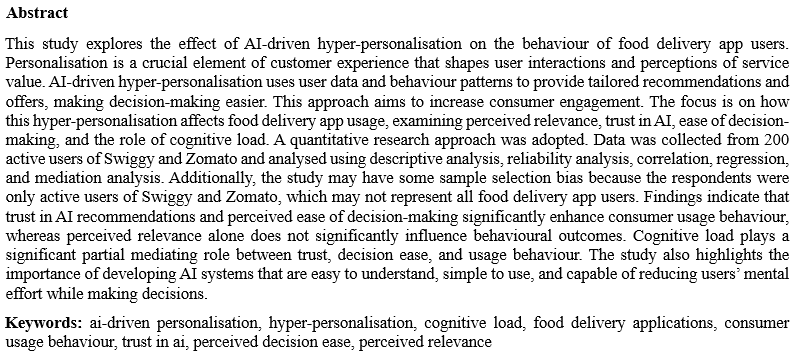
This study explores the effect of AI-driven hyper-personalisation on the behaviour of food delivery app users. Personalisation is a crucial element of customer experience that shapes user interactions and perceptions of service value. AI-driven hyper-personalisation uses user data and behaviour patterns to provide tailored recommendations and offers, making decision-making easier. This approach aims to increase consumer engagement. The focus is on how this hyper-personalisation affects food delivery app usage, examining perceived relevance, trust in AI, ease of decision-making, and the role of cognitive load. A quantitative research approach was adopted. Data was collected from 200 active users of Swiggy and Zomato and analysed using descriptive analysis, reliability analysis, correlation, regression, and mediation analysis. Additionally, the study may have some sample selection bias because the respondents were only active users of Swiggy and Zomato, which may not represent all food delivery app users. Findings indicate that trust in AI recommendations and perceived ease of decision-making significantly enhance consumer usage behaviour, whereas perceived relevance alone does not significantly influence behavioural outcomes. Cognitive load plays a significant partial mediating role between trust, decision ease, and usage behaviour. The study also highlights the importance of developing AI systems that are easy to understand, simple to use, and capable of reducing users’ mental effort while making decisions.
Downloads
References
Adomavicius, G., & Tuzhilin, A. (2005). Toward the next generation of recommender systems: A survey of the state-of-the-art and possible extensions. IEEE Transactions on Knowledge and Data Engineering, 17(6), 734–749.
Al Maalouf, M., et al. (2025). AI-powered features and customer engagement in food delivery applications. Journal of Digital Consumer Behaviour.
Alalwan, A. A., Dwivedi, Y. K., Rana, N. P., Algharabat, R., & Alalwan, H. A. (2021). Consumer adoption of AI recommendation systems: An integrated model. Journal of Business Research, 129, 190–205.
Bhattacherjee, A. (2001). Understanding information systems continuance: An expectation-confirmation model. MIS Quarterly, 25(3), 351–370.
Bleier, A., & Eisenbeiss, M. (2015). Personalised online advertising effectiveness: The interplay of what, when, and where. Marketing Science, 34(5), 669–688.
Dabholkar, P. A., & Sheng, X. (2012). Consumer participation in using online recommendation agents: Effects on satisfaction, trust, and purchase intentions. The Service Industries Journal, 32(9), 1433–1449.
Davis, F. D. (1989). Perceived usefulness, perceived ease of use, and user acceptance of information technology. MIS Quarterly, 13(3), 319–340.
Dietvorst, B. J., Simmons, J. P., & Massey, C. (2015). Algorithm aversion: People erroneously avoid algorithms after seeing them err. Journal of Experimental Psychology: General, 144(1), 114–126.
Gao, L., Waechter, K., & Bai, X. (2021). Understanding consumers' adoption of AI services: The role of perceived ease of decision-making. International Journal of Information Management, 60, 102384.
Gefen, D., Karahanna, E., & Straub, D. W. (2003). Trust and TAM in online shopping: An integrated model. MIS Quarterly, 27(1), 51–90.
Hassan, R., et al. (2025). Consumer trust and loyalty in AI-enabled digital environments. Journal of Artificial Intelligence in Marketing.
Häubl, G., & Trifts, V. (2000). Consumer decision making in online shopping environments: The effects of interactive decision aids. Marketing Science, 19(1), 4–21.
Huang, M.-H., & Rust, R. T. (2021). A strategic framework for artificial intelligence in marketing. Journal of the Academy of Marketing Science, 49(1), 30–50.
Jannach, D., & Adomavicius, G. (2016). Recommendations with a purpose. in Proceedings of the 10th ACM Conference on Recommender Systems, pp. 7–10.
Jiang, Z., Chen, Y., & Wang, Y. (2021). Building trust in AI recommendation systems: The role of transparency and accuracy. Information Processing & Management, 58(6), 102697.
Khan, S. (2025). AI-based personalised recommendations and user engagement in online food-ordering platforms. International Journal of Consumer Studies.
Li, Y., Sun, Y., Luo, X., & Zhang, Y. (2021). The role of perceived relevance in intelligent recommendation acceptance. Journal of Retailing and Consumer Services, 61, 102556.
McKnight, D. H., Choudhury, V., & Kacmar, C. (2002). Developing and validating trust measures for e-commerce: An integrative typology. Information Systems Research, 13(3), 334–359.
Paas, F., & Van Merriënboer, J. J. G. (1994). Variability of worked examples and transfer of geometrical problem-solving skills: A cognitive-load approach. Journal of Educational Psychology, 86(1), 122–133.
Patel, R., et al. (2025). AI-enabled recommendation systems and decision convenience in food delivery applications. Journal of Interactive Marketing.
Pizzi, G., Scarpi, D., & Pantano, E. (2021). Artificial intelligence and the new forms of interaction: Who has control when interacting with a chatbot? Journal of Business Research, 129, 878–890.
Shamszare, H., & Choudhury, A. (2023). Cognitive burden reduction through AI recommendation systems in online decision-making. Computers in Human Behaviour Reports, 9, 100245.
Shin, D. (2021). The effects of explainability and causability on perception, trust, and acceptance of AI systems. Telematics and Informatics, 58, 101549.
Sweller, J. (1988). Cognitive load during problem solving: Effects on learning. Cognitive Science, 12(2), 257–285.
Tam, K. Y., & Ho, S. Y. (2006). Understanding the impact of web personalisation on user information processing and decision outcomes. MIS Quarterly, 30(4), 865–890.
Venkatesh, V., Morris, M. G., Davis, G. B., & Davis, F. D. (2003). User acceptance of information technology: Toward a unified view. MIS Quarterly, 27(3), 425–478.
Wang, W., Wang, Y., & Wang, H. (2021). The effect of cognitive load on user acceptance of AI recommendation systems. Information & Management, 58(4), 103450.
Wang, X., et al. (2025). AI-powered personalised recommendations and customer engagement in food delivery platforms. Journal of Hospitality and Tourism Technology.
Xiao, B., & Benbasat, I. (2007). E-commerce product recommendation agents: Use, characteristics, and impact. MIS Quarterly, 31(1), 137–209.
Xu, H., Benbasat, I., & Cenfetelli, R. T. (2014). The effects of service and consumer attributes on privacy concerns and behavioural intentions. Journal of Management Information Systems, 30(4), 167–200.
Xu, Y., et al. (2011). Personalisation and online consumer behaviour in recommendation systems. Electronic Commerce Research and Applications.
Zhang, J., & Benbasat, I. (2004). Trust in recommender systems. Journal of Management Information Systems, 21(4), 101–136.
Published
How to Cite
Issue
Section
License
Copyright (c) 2026 Kevin John James, Dr. Praveena K

This work is licensed under a Creative Commons Attribution 4.0 International License.
Research Articles in 'Management Journal for Advanced Research' are Open Access articles published under the Creative Commons CC BY License Creative Commons Attribution 4.0 International License http://creativecommons.org/licenses/by/4.0/. This license allows you to share – copy and redistribute the material in any medium or format. Adapt – remix, transform, and build upon the material for any purpose, even commercially.


