Awareness, Perception, and Factors Influencing Higher Secondary Students' Interest in Pursuing the Four-Year Bachelor of Business Administration (BBA) Programme under the National Education Policy (NEP) 2020: A Structural Equation Modelling Approach
DOI:
https://doi.org/10.54741/MJAR/6.3.2026.318Keywords:
national education policy 2020, four-year BBA programme, higher secondary students, awareness, perception, interest, influencing factors, structural equation modelling, higher education, management educationAbstract
The implementation of the National Education Policy (NEP) 2020 has introduced significant reforms in India's higher education system, including restructuring undergraduate programmes into flexible three- and four-year degree pathways. Among these reforms, the introduction of the four-year Bachelor of Business Administration (BBA) programme offers students enhanced opportunities for multidisciplinary learning, research, internships, industry engagement, and multiple entry and exit options. Despite these policy changes, limited empirical evidence exists regarding the awareness, perception, and factors influencing Higher Secondary students' interest in pursuing the four-year BBA programme.
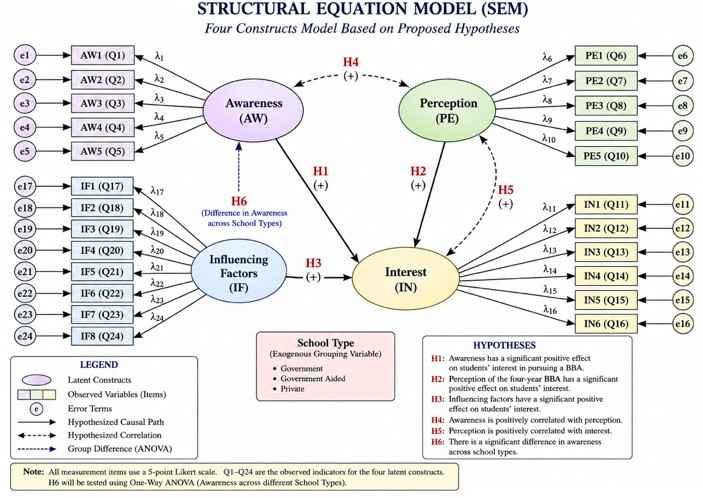
The present study investigates the awareness, perceptions, and factors influencing Higher Secondary students' interest in pursuing the four-year BBA programme under NEP 2020. A structured questionnaire comprising twenty-four Likert-scale items representing four latent constructs—Awareness, Perception, Interest, and Influencing Factors—was administered to 500 Higher Secondary students. The study employs descriptive statistics, reliability analysis, exploratory factor analysis (EFA), Pearson correlation, multiple regression, independent samples t-test, one-way ANOVA, and Structural Equation Modelling (SEM) to examine the proposed relationships among the constructs.
The findings indicate that students possess a moderate to high level of awareness regarding the four-year BBA programme. Students generally exhibit positive perceptions towards the programme, particularly regarding employability, industry exposure, research opportunities, and professional development. Business Analytics emerged as the most preferred specialisation. Correlation and regression analyses reveal that awareness, perception, and influencing factors significantly affect students' interest in pursuing the programme, with perception demonstrating the strongest predictive effect. The study also identifies significant differences in awareness across school types.
The study contributes to the emerging literature on higher education reforms under NEP 2020 by providing empirical evidence on students' programme preferences and educational decision-making. The findings offer valuable implications for policymakers, universities, educational institutions, career counsellors, and management educators seeking to improve awareness initiatives and promote management education in India.
Downloads
References
Ajzen, I. (1991). The theory of planned behavior. Organizational Behavior and Human Decision Processes, 50(2), 179–211. https://doi.org/10.1016/0749-5978(91)90020-T
Altbach, P. G. (2015). Global perspectives on higher education. Johns Hopkins University Press.
Anderson, J. C., & Gerbing, D. W. (1988). Structural equation modeling in practice: A review and recommended two-step approach. Psychological Bulletin, 103(3), 411–423. https://doi.org/10.1037/0033-2909.103.3.411
Bandura, A. (1986). Social foundations of thought and action: A social cognitive theory. Prentice Hall.
Bentler, P. M. (1990). Comparative fit indexes in structural models. Psychological Bulletin, 107(2), 238–246. https://doi.org/10.1037/0033-2909.107.2.238
Byrne, B. M. (2016). Structural equation modeling with AMOS: Basic concepts, applications, and programming (3rd ed.). Routledge.
Chin, W. W. (1998). The partial least squares approach to structural equation modeling. In G. A. Marcoulides (Ed.), Modern methods for business research (pp. 295–336). Lawrence Erlbaum Associates.
Cohen, J. (1988). Statistical power analysis for the behavioral sciences. (2nd ed.). Lawrence Erlbaum Associates.
Comrey, A. L., & Lee, H. B. (2013). A first course in factor analysis. (2nd ed.). Psychology Press.
Creswell, J. W., & Creswell, J. D. (2018). Research design: Qualitative, quantitative, and mixed methods approaches. (5th ed.). Sage Publications.
Field, A. (2018). Discovering statistics using IBM SPSS statistics. (5th ed.). Sage Publications.
Fornell, C., & Larcker, D. F. (1981). Evaluating structural equation models with unobservable variables and measurement error. Journal of Marketing Research, 18(1), 39–50. https://doi.org/10.1177/002224378101800104
George, D., & Mallery, P. (2020). IBM SPSS statistics 27 step by step: A simple guide and reference. (17th ed.). Routledge.
Hair, J. F., Black, W. C., Babin, B. J., & Anderson, R. E. (2022). Multivariate data analysis. (9th ed.). Cengage Learning.
Hair, J. F., Hult, G. T. M., Ringle, C. M., & Sarstedt, M. (2022). A primer on partial least squares structural equation modeling (PLS-SEM). (3rd ed.). Sage Publications.
Henseler, J., Ringle, C. M., & Sinkovics, R. R. (2009). The use of partial least squares path modeling in international marketing. Advances in International Marketing, 20, 277–319. https://doi.org/10.1108/S1474-7979(2009)0000020014
Hu, L. T., & Bentler, P. M. (1999). Cutoff criteria for fit indexes in covariance structure analysis: Conventional criteria versus new alternatives. Structural Equation Modeling: A Multidisciplinary Journal, 6(1), 1–55. https://doi.org/10.1080/10705519909540118
Kline, R. B. (2023). Principles and practice of structural equation modelling. (5th ed.). Guilford Press.
Kothari, C. R., & Garg, G. (2019). Research methodology: Methods and techniques. (4th ed.). New Age International Publishers.
Malhotra, N. K. (2020). Marketing research: An applied orientation. (7th ed.). Pearson Education.
Ministry of Education. (2020). National Education Policy 2020. Government of India.
Nunnally, J. C., & Bernstein, I. H. (1994). Psychometric theory. (3rd ed.). McGraw-Hill.
Podsakoff, P. M., MacKenzie, S. B., Lee, J. Y., & Podsakoff, N. P. (2003). Common method biases in behavioral research: A critical review of the literature and recommended remedies. Journal of Applied Psychology, 88(5), 879–903. https://doi.org/10.1037/0021-9010.88.5.879
Schreiber, J. B., Nora, A., Stage, F. K., Barlow, E. A., & King, J. (2006). Reporting structural equation modeling and confirmatory factor analysis results: A review. The Journal of Educational Research, 99(6), 323–338. https://doi.org/10.3200/JOER.99.6.323-338
Tabachnick, B. G., & Fidell, L. S. (2019). Using multivariate statistics. (7th ed.). Pearson.
Thompson, B. (2004). Exploratory and confirmatory factor analysis: Understanding concepts and applications. American Psychological Association.
UNESCO. (2021). Reimagining our futures together: A new social contract for education. UNESCO Publishing.
University Grants Commission. (2022). Curriculum and credit framework for undergraduate programmes. UGC.
Venkatesh, V., Morris, M. G., Davis, G. B., & Davis, F. D. (2003). User acceptance of information technology: Toward a unified view. MIS Quarterly, 27(3), 425–478. https://doi.org/10.2307/30036540
Aithal, P. S., & Aithal, S. (2020). Analysis of the Indian National Education Policy 2020 towards achieving its objectives. International Journal of Management, Technology, and Social Sciences, 5(2), 19–41.
Jena, P. K. (2020). Impact of pandemic COVID-19 on education in India. International Journal of Current Research, 12(7), 12582–12586.
Kumar, K., & Singh, R. (2022). Students' perception towards multidisciplinary education under NEP 2020. Journal of Higher Education Policy and Leadership Studies, 3(2), 55–71.
Sharma, R., & Gupta, A. (2023). Awareness and acceptance of NEP 2020 among higher secondary students in India. International Journal of Educational Development, 98, 102756.
Singh, P., & Verma, S. (2023). Factors influencing students' choice of undergraduate management education in India. Journal of Education and Work, 36(4), 305–320.
Published
How to Cite
Issue
Section
License
Copyright (c) 2026 Raunak Bhattacharyya, Sumit Samaddar

This work is licensed under a Creative Commons Attribution 4.0 International License.
Research Articles in 'Management Journal for Advanced Research' are Open Access articles published under the Creative Commons CC BY License Creative Commons Attribution 4.0 International License http://creativecommons.org/licenses/by/4.0/. This license allows you to share – copy and redistribute the material in any medium or format. Adapt – remix, transform, and build upon the material for any purpose, even commercially.


