Gender Participation, Diversity and Organisational Behaviour: Examining Workforce Inclusion and Gender Equity in Contemporary India
DOI:
https://doi.org/10.54741/MJAR/6.2.2026.311Keywords:
gender participation, workforce diversity, organisational behaviour, gender equality, inclusion, labour force participation, leadership diversity, indiaAbstract
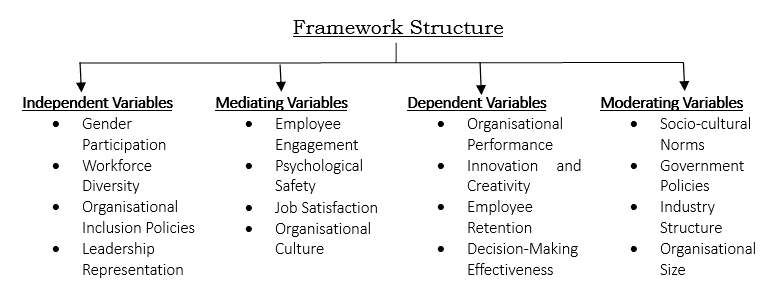
Gender participation and workforce diversity have emerged as critical determinants of organisational effectiveness, economic development and social progress in the twenty-first century. Despite substantial advancements in education, legal protections and policy interventions, India continues to experience significant gender disparities in labour force participation, leadership representation, wages and workplace inclusion. According to the Global Gender Gap Report 2022, India ranked 135th among 146 countries, highlighting persistent challenges in economic participation and opportunity. This study examines the relationship between gender participation, diversity and organisational behaviour within the Indian context by integrating socio-cultural, historical, economic, and organisational perspectives. Drawing upon secondary data from international reports, government publications and academic literature, the study analyses the structural barriers affecting women and gender minorities in the workforce and evaluates the implications of gender diversity for organisational performance. The paper argues that inclusive workplace cultures, equitable employment practices and diversity-oriented leadership contribute significantly to innovation, employee engagement, decision-making effectiveness and organisational sustainability. Furthermore, it highlights the need for comprehensive policy reforms and behavioural transformation within organisations to achieve meaningful gender parity. The findings suggest that gender diversity should be viewed not merely as a social justice objective but as a strategic imperative for organisational excellence and national development.
Downloads
References
World Economic Forum. (2022). Global gender gap report 2022. World Economic Forum.
World Bank. (2018). Unrealized potential: The high cost of gender inequality in earnings. World Bank.
Centre for Monitoring Indian Economy (CMIE). (2022). Labour force participation data and economic outlook. CMIE.
International Labour Organization. (2023). World employment and social outlook. ILO.
National Sample Survey Office (NSSO). (Latest available). Periodic Labour Force Survey (PLFS). Government of India.
Eagly, A. H. (1987). Sex differences in social behavior: A social role interpretation. Lawrence Erlbaum Associates.
Morrison, A. M., White, R. P., & Van Velsor, E. (1987). Breaking the glass ceiling. Addison-Wesley.
Oxfam India. (2022). Women’s workforce participation in India. Oxfam.
Catalyst. (2021). Why diversity and inclusion matter. Catalyst.
Published
How to Cite
Issue
Section
License
Copyright (c) 2026 Md. Sharique Imroze

This work is licensed under a Creative Commons Attribution 4.0 International License.
Research Articles in 'Management Journal for Advanced Research' are Open Access articles published under the Creative Commons CC BY License Creative Commons Attribution 4.0 International License http://creativecommons.org/licenses/by/4.0/. This license allows you to share – copy and redistribute the material in any medium or format. Adapt – remix, transform, and build upon the material for any purpose, even commercially.


