Social Media Marketing: A Conceptual Framework of Components, Strategies, and Emerging Trends
DOI:
https://doi.org/10.54741/MJAR/6.3.2026.307Keywords:
social media marketing, consumer behaviour, influencer marketing, social commerce, digital marketing strategy, brand awarenessAbstract
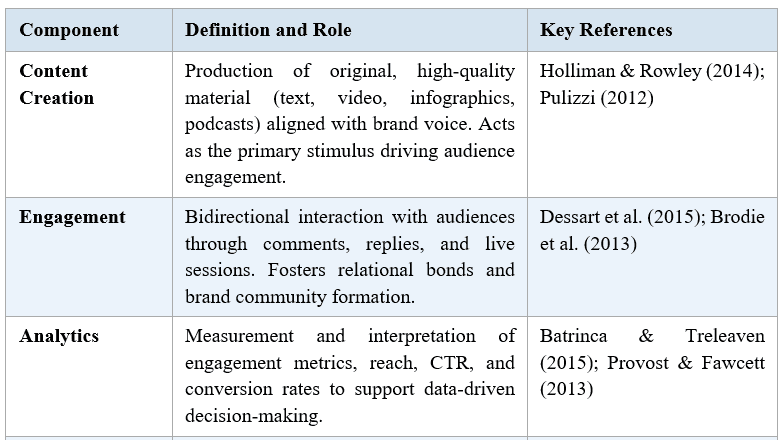
This paper develops a comprehensive conceptual framework for social media marketing (SMM), synthesizing the extant literature on its core components, strategic dimensions, and impact on consumer behaviour and business performance. A systematic review of peer-reviewed journal articles, industry reports, and authoritative texts published between 2010 and 2024 was conducted using Google Scholar, JSTOR, and Scopus databases. Thematic analysis was employed to identify recurring patterns and emerging directions. The study identifies nine foundational SMM components—content creation, engagement, analytics, advertising, social listening, influencer marketing, community management, crisis management, and platform selection—and synthesizes them into an integrated effectiveness model. Evidence suggests that SMM significantly enhances brand awareness, shapes purchase decisions through social proof and contributes to measurable improvements in sales and customer loyalty. Persistent challenges include algorithm volatility, content saturation, and return-on-investment (ROI) quantification. The paper’s primary contribution is a unified conceptual model that integrates SMM components, strategies, and performance outcomes, offering both academic grounding and a practitioner-oriented decision framework. Implications for future research and managerial practice are discussed.
Downloads
References
Algesheimer, R., Dholakia, U. M., & Herrmann, A. (2005). The social influence of brand community: Evidence from European car clubs. Journal of Marketing, 69(3), 19–34.
Appel, G., Grewal, L., Hadi, R., & Stephen, A. T. (2020). The future of social media in marketing. Journal of the Academy of Marketing Science, 48(1), 79–95.
Barney, J. (1991). Firm resources and sustained competitive advantage. Journal of Management, 17(1), 99–120.
Batrinca, B., & Treleaven, P. C. (2015). Social media analytics: A survey of techniques, tools and platforms. AI & Society, 30(1), 89–116.
Braun, V., & Clarke, V. (2006). Using thematic analysis in psychology. Qualitative Research in Psychology, 3(2), 77–101.
Brodie, R. J., Ilic, A., Juric, B., & Hollebeek, L. (2013). Consumer engagement in a virtual brand community. Journal of Business Research, 66(1), 105–114.
Canhoto, A. I., & Padmanabhan, Y. (2019). ‘We(’re all) are in this together’: Revisiting the concept of marketing ‘customer’ in the context of social media. Journal of Marketing Management, 35(5–6), 426–443.
Chaffey, D., & Ellis-Chadwick, F. (2022). Digital marketing: Strategy, implementation and practice. (8th ed.). Pearson.
Cheung, C. M. K., & Thadani, D. R. (2012). The impact of electronic word-of-mouth communication. Decision Support Systems, 54(1), 461–470.
Cialdini, R. B. (2001). Influence: Science and practice. (4th ed.). Allyn & Bacon.
Cisco. (2023). Cisco annual internet report. Cisco Systems.
Coombs, W. T. (2014). Ongoing crisis communication: Planning, managing, and responding. (4th ed.). SAGE.
Culnan, M. J., McHugh, P. J., & Zubillaga, J. I. (2010). How large US companies can use Twitter and other social media to gain business value. MIS Quarterly Executive, 9(4), 243–259.
Dessart, L., Veloutsou, C., & Morgan-Thomas, A. (2015). Consumer engagement in online brand communities. Journal of Product & Brand Management, 24(1), 28–42.
De Veirman, M., Cauberghe, V., & Hudders, L. (2017). Marketing through Instagram influencers. International Journal of Advertising, 36(5), 798–828.
Edelman. (2024). Edelman trust barometer. Edelman intelligence.
eMarketer. (2023). Global social commerce forecast 2023–2025. Insider Intelligence.
Fournier, S., & Avery, J. (2011). The uninvited brand. Business Horizons, 54(3), 193–207.
Goh, K.-Y., Heng, C.-S., & Lin, Z. (2013). Social media brand community and consumer behaviour. Information Systems Research, 24(1), 88–107.
Holliman, G., & Rowley, J. (2014). Business to business digital content marketing. Journal of Research in Interactive Marketing, 8(4), 269–293.
Huang, M.-H., & Rust, R. T. (2021). A strategic framework for artificial intelligence in marketing. Journal of the Academy of Marketing Science, 49(1), 30–50.
Javornik, A. (2016). Augmented reality: Research agenda for studying the impact of its media characteristics on consumer behaviour. Journal of Retailing and Consumer Services, 30, 252–261.
Jin, Y., Liu, B. F., & Austin, L. L. (2014). Examining the role of social media in effective crisis management. Communication Research, 41(1), 74– 94.
Kaplan, A. M., & Haenlein, M. (2010). Users of the world, unite! The challenges and opportunities of social media. Business Horizons, 53(1), 59–68.
Keller, K. L. (2013). Strategic brand management. (4th ed.). Pearson.
Kemp, S. (2024). Digital 2024: Global overview report. DataReportal.
Kietzmann, J. H., Hermkens, K., McCarthy, I. P., & Silvestre, B. S. (2011). Social media? Get serious! Understanding the functional building blocks of social media. Business Horizons, 54(3), 241–251.
Kumar, V., Aksoy, L., Donkers, B., Venkatesan, R., Wiesel, T., & Tillmanns, S. (2010). Undervalued or overvalued customers. Journal of Service Research, 13(3), 297–310.
Lambrecht, A., & Tucker, C. (2013). When does retargeting work? Information specificity in online advertising. Journal of Marketing Research, 50(5), 561–576.
Li, H., & Kannan, P. K. (2014). Attributing conversions in a multichannel online marketing environment. Journal of Marketing Research, 51(1), 40–56.
Libert, B., Beck, M., & Wind, J. (2016). The network imperative. Harvard Business Review Press.
Lou, C., & Yuan, S. (2019). Influencer marketing: How message value and credibility affect consumer trust of branded content on social media. Journal of Interactive Advertising, 19(1), 58–73.
McAlexander, J. H., Schouten, J. W., & Koenig, H. F. (2002). Building brand community. Journal of Marketing, 66(1), 38–54.
Mehrabian, A., & Russell, J. A. (1974). An approach to environmental psychology. MIT Press.
Meta. (2024). Meta investor relations: Q4 2023 earnings report. Meta Platforms.
Muniz, A. M., & O’Guinn, T. C. (2001). Brand community. Journal of Consumer Research, 27(4), 412–432.
Petty, R. E., & Cacioppo, J. T. (1986). The elaboration likelihood model of persuasion. Advances in Experimental Social Psychology, 19, 123–205.
Prahalad, C. K., & Ramaswamy, V. (2004). Co-creation experiences: The next practice in value creation. Journal of Interactive Marketing, 18(3), 5–14.
Pulizzi, J. (2012). The rise of storytelling as the new marketing. Publishing Research Quarterly, 28(2), 116–123.
Sigala, M. (2018). New technologies in tourism: From multi-disciplinary to anti-disciplinary advances and trajectories. Tourism Management Perspectives, 25, 151–155.
Statista. (2024). Number of social media users worldwide 2017–2028. Statista Research Department.
Tajvidi, R., & Karami, A. (2021). The effect of using social media, traditional media, and digital marketing on social media performance of SMEs. Journal of Strategic Marketing, 29(6), 521–539.
Teece, D. J., Pisano, G., & Shuen, A. (1997). Dynamic capabilities and strategic management. Strategic Management Journal, 18(7), 509–533.
Tranfield, D., Denyer, D., & Smart, P. (2003). Towards a methodology for developing evidence-informed management knowledge by means of systematic review. British Journal of Management, 14(3), 207–222.
Tuten, T. L., & Solomon, M. R. (2022). Social media marketing. (4th ed.). SAGE Publications.
Zajonc, R. B. (1968). Attitudinal effects of mere exposure. Journal of Personality and Social Psychology Monograph Supplement, 9(2), 1–27.
Zhang, K. Z. K., Xu, H., Zhao, S., & Yu, Y. (2014). Online reviews and impulse buying behaviour. Journal of Computer Information Systems, 58(3), 205–214.
Published
How to Cite
Issue
Section
License
Copyright (c) 2026 Dr. Ashutosh Singh

This work is licensed under a Creative Commons Attribution 4.0 International License.
Research Articles in 'Management Journal for Advanced Research' are Open Access articles published under the Creative Commons CC BY License Creative Commons Attribution 4.0 International License http://creativecommons.org/licenses/by/4.0/. This license allows you to share – copy and redistribute the material in any medium or format. Adapt – remix, transform, and build upon the material for any purpose, even commercially.


