The BRICS Climate Dilemma: Reconciling Development, Energy Security, and Net-Zero Goals
DOI:
https://doi.org/10.54741/MJAR/6.2.2026.306Keywords:
BRICS, climate governance, energy transition, net zero, sustainable development, climate financeAbstract
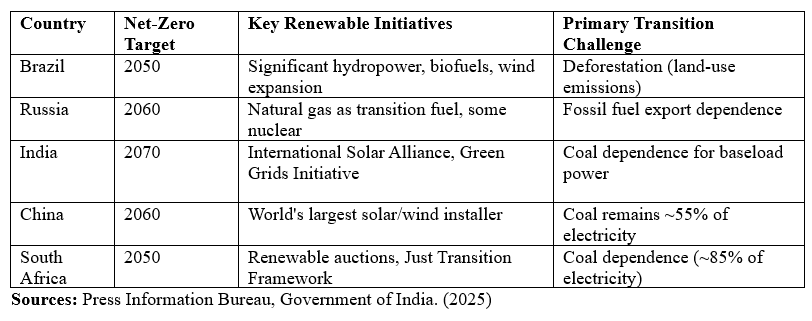
The BRICS nations (Brazil, Russia, India, China, and South Africa) are highly populated, home to half of the world’s population, and account for nearly 40% of the global greenhouse gas emissions. Therefore, their role in global climate change is extremely important. This study investigates the sustainability strategies, policies, and governance structures used by BRICS countries to reconcile economic development with net-zero targets. Three major findings were determined during this study. First, the BRICS have created several cooperative groups i.e. New Development Bank and Energy Cooperation Roadmap 2025-2030. These groups support collaborative methods for BRICS nations to address climate change. However, these groups are not subject to compliance/regulation like other nations. Second, each BRICS country has developed an individual plan to reduce greenhouse gas emissions, with varying timelines for their completion (ranging from 2050 to 2070) due to each country being at different developmental levels. For example, some BRICS countries are relying on fossil fuels significantly at this time. Third, a continuing barrier to implementation is the high level of financing currently available. Despite climate finance flows of only about USD 1.3 trillion (mailed drop) in total per year needed for effective and sustainable transformation, current flows of climate finance (in total) are well below this figure. This paper proposes a practical climate governance framework tailored for emerging economies like BRICS nations. It features the BRICS climate governance model, incorporating key principles of differentiated responsibility, shared financing mechanisms, and strategic leveraging of multilateral institutions.
Downloads
References
BRICS Brasil. (2025). Commitment to a just and financially feasible energy transition marks. BRICS Joint Energy Statement.
BRICS Brasil. (2025). BRICS and the transformation of global cooperation in the face of the climate crisis.
NITI Aayog, India. (2026). PM's main statement in the BRICS leaders' meeting.
Discover Sustainability. (2025). Climate governance in the BRICS: pathways toward net-zero emissions. Article 359.
Press Information Bureau, Government of India. (2025). India calls on BRICS to unite on 'Baku to Belem Roadmap'.
UN Trade and Development (UNCTAD). (2025). Fostering BRICS leadership on climate ambition amid trade and climate tensions.
BRICS Brazil. (2025). BRICS approves declaration and advances sustainable industrial agenda with focus on technology and small businesses.
International Institute for Trade and Development. (2025). BRICS and the development of financial mechanisms toward a green economy.
Published
How to Cite
Issue
Section
License
Copyright (c) 2026 Ajit Singh, Monica

This work is licensed under a Creative Commons Attribution 4.0 International License.
Research Articles in 'Management Journal for Advanced Research' are Open Access articles published under the Creative Commons CC BY License Creative Commons Attribution 4.0 International License http://creativecommons.org/licenses/by/4.0/. This license allows you to share – copy and redistribute the material in any medium or format. Adapt – remix, transform, and build upon the material for any purpose, even commercially.


