Effectiveness of the Constituency Development Fund Accountability Framework in Service Delivery: Evidence from Chawama and Kanyama Constituencies, Lusaka, Zambia
DOI:
https://doi.org/10.54741/MJAR/6.2.2026.303Keywords:
effectiveness, constituency development fund, accountability framework, financial management, transparency, monitoring & evaluation service deliveryAbstract
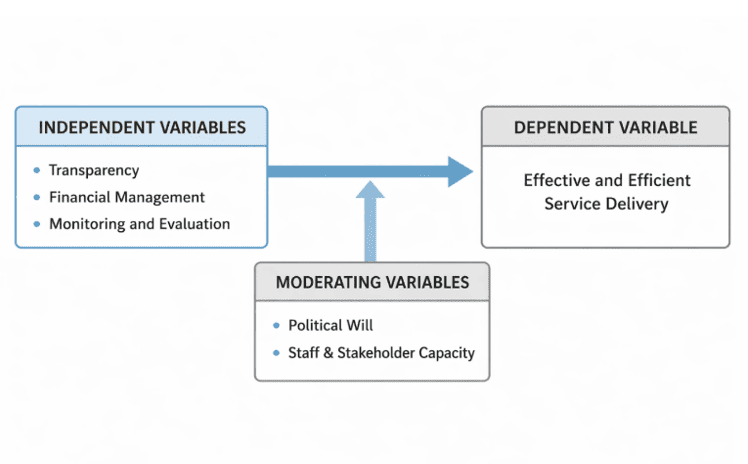
The Constituency Development Fund (CDF) in Zambia has become a central fiscal decentralization tool aimed at fostering inclusive development and improve service delivery at the constituency level. This study assessed the effectiveness of the CDF accountability framework on service delivery in Chawama and Kanyama constituencies of Lusaka, Zambia. Specifically, it examined stakeholders’ perceptions of key accountability elements, assessed the effectiveness of accountability elements on service delivery and critically analysed challenges affecting CDF accountability. Employing a convergent parallel mixed‑methods design, the study integrated quantitative data from structured questionnaires administered to 193 stratified random respondents (144 returned; 75% response rate) with qualitative insights from 18 purposively selected informants, including CDF Committee members, Ward Development Committees, council officers, and community representatives. Reliability and validity were ensured through pre-testing, triangulation and consistency in checks. Quantitative data were analysed using descriptive and inferential statistics in SPSS, while qualitative data were analysed thematically. Findings reveal that transparency, financial management and M&E significantly influence service delivery, with financial management emerging as the most critical driver of service delivery outcomes. However, the full realization of the fund’s developmental impact is constrained by political interference, limited technical capacity, inadequate financial reporting, bureaucratic delays, weak monitoring systems, and restricted information disclosure. The study concludes that while the CDF accountability framework in Chawama and Kanyama constituencies is structurally well-established, its effectiveness in improving service delivery is constrained by weak enforcement, limited capacity, and operational inefficiencies. The study stresses the necessity of strengthening transparency, building CDF committee capacity, financial management through results‑based financing linked to verified outputs. It further underscores the need for stronger monitoring and evaluation and enforcing independent audits to ensure compliance and improve the effectiveness of service delivery.
Downloads
References
Afrobarometer. (2022). Accountability and the role of civil society in Africa. Available at: https://afrobarometer.org (Accessed: 21 August 2025).
Andriyansah, A. (2021). Analysis of financial performance using budget absorption indicators. Budapest International Research and Critics Institute (BIRCI) Journal: Humanities and Social Sciences, 4(1), 636–647. https://doi.org/10.33258/BIRCI.V4I1.1775
Auditor General of Zambia. (2023). Annual report on the accounts of the Republic. Lusaka: Government Printer.
Auditor General of Zambia. (2024). Annual report of the Auditor General on the accounts of the Constituency Development Fund. Lusaka: Office of the Auditor General.
Akwalu, J.N., & Muchai, S. (2020). Constituency Development Fund (CDF) and its effects on community welfare in Tigania East Constituency, Meru County, Kenya. Journal of Poverty, Investment and Development, 5, 12–35. https://doi.org/10.47604/jpid.1097
Ayee, J.R.A. (2020). Decentralization and accountability in Sub-Saharan Africa: An analytical framework. African Studies Review, 63(4), 754–772.
Baskin, M. (2010). Constituency development funds as a tool for development. Centre for International Development.
Blair, H. (2017). Constituency development funds in India. Economic & Political Weekly, 52(31), 99.
Bovens, M., Goodin, R.E., & Schillemans, T. (2021). The Oxford handbook of public accountability. (2nd ed.). Oxford: Oxford University Press.
Braun, V., & Clarke, V. (2006). Using thematic analysis in psychology. Qualitative Research in Psychology, 3(2), 77–101. https://doi.org/10.1191/1478088706qp063oa
Commonwealth Parliamentary Association. (2016). Handbook on constituency development funds (CDFs): Principles and tools for parliamentarians. London: CPA.
Creswell, J.W. (2009). Research design: Qualitative, quantitative, and mixed methods approaches. (3rd ed.). Thousand Oaks, CA: Sage.
Fox, J. (2022). Social accountability: What does the evidence really say? World Development, 150, 105711. https://doi.org/10.1016/j.worlddev.2021.105711
Hapompwe, C.C., Tembo, M.N., Kukano, C., & Siwale, J. (2020). An investigation into the impact of Constituency Development Fund (CDF) on rural development with special reference to education and health sectors in Rufunsa Constituency. International Journal of Scientific and Research Publications, 10(6), 388.
Kaira, J., & Kajoba, G. (2025). Constituency Development Fund (CDF) as a tool for infrastructure development in the context of decentralization and devolution in Zambia: A case study of Kabwe Central Constituency. Social Sciences, 14, 233–251. https://doi.org/10.11648/j.ss.20251403.15
Keefer, P., & Khemani, S. (2009). When do legislators pass on “pork”? The determinants of legislator utilization of a constituency development fund in India. World Bank Policy Research Working Paper No. 4929. Washington, DC: World Bank.
Liswaniso, M., & Chisala, B. (2026). Assessing the effectiveness of Constituency Development Fund (CDF) implementation strategies on community development outcomes in Chawama Constituency, Zambia: A case study of Lusaka District. International Journal of Innovative Science and Research Technology, 11(2), 3092–3102.
Lubinga, B.H., & Chibomba, K. (2026). Examining citizen engagement in participatory constituency development funds: Case study of the Mbala CDF Municipal Council. International Journal of Advanced Multidisciplinary Research Studies, 6, 393–402. https://doi.org/10.62225/2583049x.2026.6.1.5564
Malik, R. (2021). (A)political constituency development funds: Evidence from Pakistan. British Journal of Political Science, 51(3), 963–980. https://doi.org/10.1017/S0007123419000541
Matipa, B. (2019). The extent of community participation in Constituency Development Fund (CDF) project identification in Mwense Constituency. International Journal of Public Administration, 43, 668–681. https://doi.org/10.1080/01900692.2019.1645686
Muyaloka, D., & Kachamba, N. (2024). Assessing factors influencing the failure of Constituency Development Fund (CDF) projects in education and health sectors in Zambia: A critical analysis. African Journal of Commerce Studies, 4, 225–251. https://doi.org/10.59413/ajocs/v4.i3.6
Mwanangombe, E., & Haabazoka, L. (2025). The effects of Constituency Development Fund (CDF) on education sector growth: The case of Luano District, Zambia. International Journal of Novel Research and Development, 10, 948–964.
Ndalamei, A.S., & Phiri, J. (2026). Analysing the effectiveness of Constituency Development Fund (CDF) on youth empowerment in Zambia: A case of Lusaka Central Constituency. African Journal of Commerce Studies, 7, 352–371. https://doi.org/10.59413/ajocs/v7.i2.31
Organisation for Economic Co-operation and Development (OECD). (2020). Enhancing public sector accountability. Paris: OECD Publishing.
Organisation for Economic Co-operation and Development (OECD). (2021). Building trust and reinforcing democracy. Paris: OECD Publishing.
Smoke, P. (2015). Rethinking decentralization: Assessing challenges to a popular public sector reform. Public Administration and Development, 35(2), 97–112. https://doi.org/10.1002/pad.1703
Tashakkori, A., & Teddlie, C. (2003). Handbook of mixed methods in social and behavioral research. Thousand Oaks, CA: Sage.
Thomas, P.S., & Makwai, A.I. (2022). Community participation in the Constituency Development Catalyst Fund: A case of Bahi District, Tanzania. East African Journal of Management and Business Studies, 2. https://doi.org/10.46606/eajmbs2022v02i03.0011
Transparency International Zambia. (2025). Public accountability and Constituency Development Fund report. Lusaka: TI-Z.
United Nations Development Programme (UNDP). (2022). Governance for resilient development. New York: UNDP.
Wampler, B. (2022). Participatory budgeting in global perspective. In Wampler, B., McNulty, S., & Touchton, M. (Eds.), Participatory budgeting in global perspective. Oxford: Oxford University Press.
World Bank. (2020). Enhancing government effectiveness and transparency. Washington, DC: World Bank Group.
World Bank. (2023). Zambia public expenditure review. Washington, DC: World Bank Group.
Yamane, T. (1967). Statistics: An introductory analysis. (2nd ed.). New York: Harper & Row.
Zyl, A.V. (2010). What is wrong with the constituency development funds? International Budget Partnership. Available at: https://www.internationalbudget.org
Published
How to Cite
Issue
Section
License
Copyright (c) 2026 Angela Chambaka, Bupe Getrude Mutono- Mwanza

This work is licensed under a Creative Commons Attribution 4.0 International License.
Research Articles in 'Management Journal for Advanced Research' are Open Access articles published under the Creative Commons CC BY License Creative Commons Attribution 4.0 International License http://creativecommons.org/licenses/by/4.0/. This license allows you to share – copy and redistribute the material in any medium or format. Adapt – remix, transform, and build upon the material for any purpose, even commercially.


