Role of NABARD’S SHGS-Bank Linkage Programme in Making the Dream True of Self-Help Groups in India
DOI:
https://doi.org/10.54741/MJAR/6.2.2026.299Keywords:
SHG¬-BLP, SHG, women empowerment, financial literacyAbstract
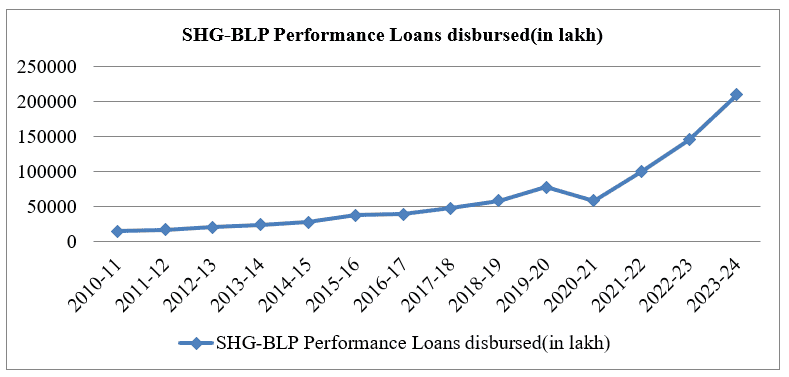
The study is basically focused on NABARD’s SHG-bank linkage program (SHG-BLP), BLP’S contribution on fulfilling the motive of SHG groups, which is to improve the condition of financial literacy among the women, especially those women who are belonging to those areas where the availability of banking facilities is very low or negligible. In this regard, NABARD is promoting self-help groups through linking them with the banks for their better and easy performance to provide financial and security support, like availability of loans and collecting savings. The SHG-BLP was started in 1992-93 as a preparatory project to link around five hundred poor households. Study found that the overall contribution of this program for serving better facilities is very effective. Both the SHG bank linkage with bank through their saving amounts and distribution of loans are showing an increasing trend, but the outstanding amount of loans is in a negative trend, which is showing kind of some inefficient work of banks in recovering the loan amount, but in the end we can say that banks are contributing a lot to women's empowerment, making them independent, and their overall socio-economic development. Banks are really helping in achieving the motive of SHG.
Downloads
References
Ajitesh Kumar, M. A. (2024). Impact of bank linkage programme on self-help groups: Achievements, challenges and the way forward. Mumbai: Department of Economic Analysis and Research (DEAR), NABARD Head Office, Mumbai.
M.G., R. (2024). Performance of shgs-bank linkage programme for financial inclusion in India. EPRA International Journal of Multidisciplinary Research (IJMR), 10(9), 484-487.
Pandey, M. (2023). Self Help Groups (SHGs): History, progress and success stories. International Journal of Creative Research Thoughts (IJCRT), 11(9), 325-335.
Reserve Bank Of India. (2024, April 16). Retrieved March 21, 2026, from Master Circulars: https://www.rbi.org.in/scripts/BS_ViewMasterCirculars.aspx?Id=12665
Mishra, S., & Dr. Nagwanshee, R. (2025). An analysis of self-help groups in india: trends, regional status, and the role of banks. Jamshedpur Research Review, 5(73), 26-33.
NABARD. (2023-24). Highlights of the SHG-bank linkage programme 2022-23. NABARD.
Government of India. (2026, March 22). Retrieved March 24, 2026, from Ministry of Rural Development: https://nrlm.gov.in/outerReportAction.do?methodName=showIndex#gsc.tab=0
Published
How to Cite
Issue
Section
License
Copyright (c) 2026 Shimple Mishra, Aprajita Sawaran, Rajkumar Nagwanshee

This work is licensed under a Creative Commons Attribution 4.0 International License.
Research Articles in 'Management Journal for Advanced Research' are Open Access articles published under the Creative Commons CC BY License Creative Commons Attribution 4.0 International License http://creativecommons.org/licenses/by/4.0/. This license allows you to share – copy and redistribute the material in any medium or format. Adapt – remix, transform, and build upon the material for any purpose, even commercially.


