The Hidden Cost of Compounding: An Analysis of Mutual Fund Fee Structures and Long-Term Returns
DOI:
https://doi.org/10.54741/MJAR/6.1.2026.288Keywords:
cost of compounding, total expense ratio, mutual funds, long term returns, net asset value, asset under managementAbstract
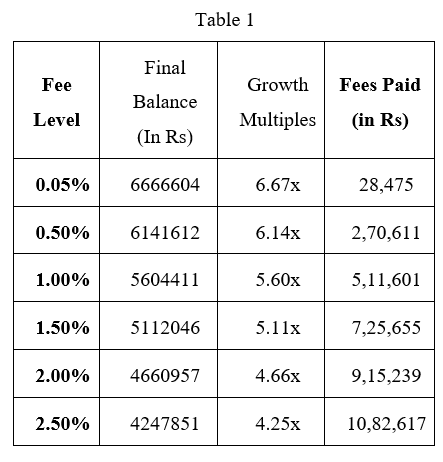
This paper analyzes the impact of Expense Ratios (TER) and hidden transaction costs on the long-term performance of mutual funds. This study demonstrates an inverse relationship between fees and net returns. The findings indicate that small, yearly fees compound into massive wealth erosion over 10–20 years, with over 80% of active funds in some categories failing to outperform passive alternatives after fees. The "hidden" cost of fees is not just the payment itself, but the lost opportunity cost of that money failing to compound.
Downloads
References
https://www.kotak.bank.in/en/stories-in-focus/mutual-funds/what-is-ter.html
https://www.investopedia.com/terms/n/nav.asp
https://www.investopedia.com/terms/a/activemanagement.asp
https://www.angelone.in/smart-money/mutual-fund-courses/passive-fund-management
https://finxpert.org/active-vs-passive-funds-which-perform-better-in-india
Akshay Ganapati Naik, & Bhavya Vikas. (2024). A study on impact of expense ratio on mutual performance. International Journal of Emerging Technologies and Innovative Research, 11(9), c122-c131.
Published
How to Cite
Issue
Section
License
Copyright (c) 2026 Chitranjan Singh

This work is licensed under a Creative Commons Attribution 4.0 International License.
Research Articles in 'Management Journal for Advanced Research' are Open Access articles published under the Creative Commons CC BY License Creative Commons Attribution 4.0 International License http://creativecommons.org/licenses/by/4.0/. This license allows you to share – copy and redistribute the material in any medium or format. Adapt – remix, transform, and build upon the material for any purpose, even commercially.


