A Study on Assessing Logistics Constraints of Tourism Supply Chain Persistence in Remote Island Destinations: Insights from the Andaman and Nicobar Islands
DOI:
https://doi.org/10.54741/MJAR/6.2.2026.287Keywords:
tourism supply chain, logistics constraints, supply chain persistence, island tourism, transport connectivity, infrastructure quality, logistics coordination, inventory management, sustainable tourism, regional tourism development, tourism policy, logistics optimization, crisis management, disaster resilience andaman and nicobar islandsAbstract
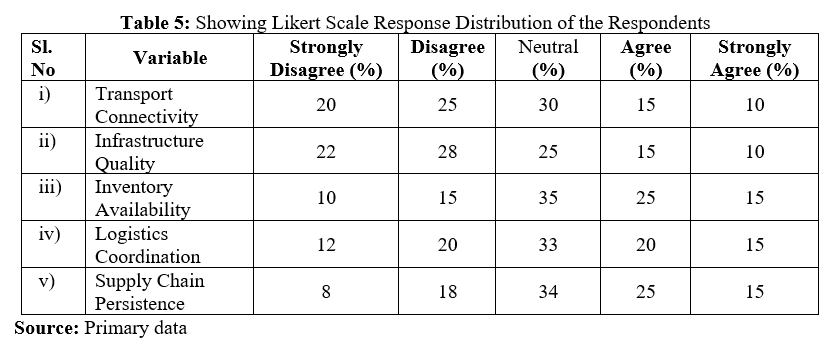
Tourism plays a vital role in economic development, particularly in geographically isolated regions such as the Andaman and Nicobar Islands, where natural resources and biodiversity attract increasing tourist inflows. However, tourism operations in remote island destinations are significantly constrained by logistics and supply chain challenges. This study examines the impact of logistics constraints on tourism supply chain persistence across selected remote island destinations, including Diglipur, Mayabunder, Rangat, Baratang, Hut Bay, and Campbell Bay. A cross-sectional quantitative research design was adopted, and primary data were collected from 100 tourism agencies, including hotels, tour operators, and travel agencies. Data were analyzed using statistical tools such as descriptive statistics, correlation, regression, and chi-square tests through SPSS. The findings reveal that transport connectivity and infrastructure quality remain below average, indicating significant dissatisfaction among tourism stakeholders. The study further identifies critical logistics constraints, including limited inter-island connectivity, irregular transport schedules, mainland supply dependency, and high transportation costs, all of which significantly disrupt tourism operations. The results confirm that logistics constraints have a statistically significant impact on tourism supply chain persistence, leading to the rejection of the null hypothesis. The study contributes to the existing literature by providing empirical insights into logistics-driven tourism supply chain challenges in remote island contexts, an area that remains underexplored in India. It also offers policy recommendations focusing on infrastructure development, digital logistics integration, stakeholder coordination, and sustainable supply chain practices. These findings are expected to support policymakers and tourism stakeholders in enhancing supply chain resilience and ensuring sustainable tourism development in remote island destinations.
Downloads
References
Adetoba, O. M., Hassan, I. K., Fatile, J. O., & Genty, K. I. (2025). Emerging technologies and sustainability issues: Assessing Lagos State policy on globalization of supply chain infrastructure. International Journal of Advanced Research in Accounting, Economics and Business Perspectives, 9(1).
Albalate, D., Campos, J., & Jiménez, J. L. (2017). Tourism and high-speed rail in Spain: Does the AVE increase local visitors? Annals of Tourism Research, 65, 71–82.
Alsharif, A., Isa, S. M., & Alqudah, M. N. (2024). Smart tourism, hospitality, and destination: A systematic review and future directions. Journal of Tourism and Services, 15(29).
Brida, J. G., & Zapata, S. (2010). Cruise tourism: Economic, socio-cultural and environmental impacts. International Journal of Leisure and Tourism Marketing, 1(3), 205–226.
Christopher, M., & Peck, H. (2004). Building the resilient supply chain. The International Journal of Logistics Management, 15(2), 1–14.
Census of India 2011: District census handbook – Andaman and Nicobar Islands. Government of India.
Deshmukh, G. A., & Mutha, N. (2025). Analysing the supply chain dynamics in Indian tourism. Management Journal for Advanced Research, 5(5).
Junton, P., & Kamthornphiphatthanakul, S. (2023). Tourism logistics management influencing logistics performance, satisfaction, and loyalty of tourists in Songkhla Province. International Journal of Management Studies and Social Science Research, 5(6).
Mandal, S., & Saravanan, D. (2019). Exploring the influence of strategic flexibility on tourism supply chain resilience. Tourism Management Perspectives, 32, 100561.
Mishra, K. K., Singh, C., Mishra, S. K., & Son, K. (2024). Enhancing tourism experiences through efficient logistics and supply chain practices. ShodhKosh: Journal of Visual and Performing Arts.
Ponomarov, S. Y., & Holcomb, M. C. (2009). Understanding the concept of supply chain resilience. The International Journal of Logistics Management, 20(1), 124–143.
Putranto, D., Halawa, F. A., Widodo, R. E., Setiawan, F., & Ajizi, B. N. (2025). The role of logistics management in ecotourism sustainability: Exploring stakeholder practices in minimizing environmental impact at regional destinations. International Journal of Integrative Sciences, 4(11), 2705–2730.
Reid, S., & Johnson, C. (2024). Assessing Jamaica's logistics hub initiative and its implications for sustainable development. International Journal of Scientific Research and Management, 12(9), 15–30.
Samal, R., & Dash, M. (2022). Ecotourism, biodiversity conservation and livelihoods: Understanding the convergence and divergence. International Journal of Geoheritage and Parks.
Umar, M., Ahmad, R., & Radics, R. (2022). Tourism supply chains: Issues and resilience strategies during the global pandemic. Australasian Journal of Disaster and Trauma Studies, 26(Special Issue).
Zaini, Z., Maulamin, T., Asad, M., Ismowati, M., Halim, P., Badruddin, S., & Istianto, B. (2020). Tourism supply chain management: Evidence from tourism and hospitality industry of Indonesia. International Journal of Supply Chain Management, 9(1).
Published
How to Cite
Issue
Section
License
Copyright (c) 2026 Meera Setty BSV

This work is licensed under a Creative Commons Attribution 4.0 International License.
Research Articles in 'Management Journal for Advanced Research' are Open Access articles published under the Creative Commons CC BY License Creative Commons Attribution 4.0 International License http://creativecommons.org/licenses/by/4.0/. This license allows you to share – copy and redistribute the material in any medium or format. Adapt – remix, transform, and build upon the material for any purpose, even commercially.


