Mutual Fund as Drivers of Socially Responsible Investment: An Empirical Study on Selected ESG-Themed Mutual Funds in India
DOI:
https://doi.org/10.54741/MJAR/6.1.2026.285Keywords:
socially responsible investment (SRI), ESG-themed mutual funds, sustainable finance, impact investment, responsible investmentAbstract
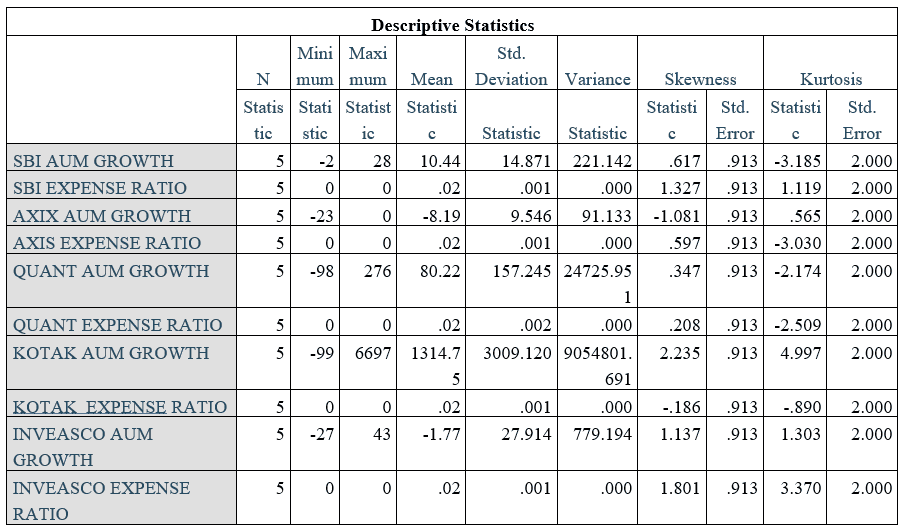
Socially Responsible Investment (SRI) is an investment approach that incorporates ethical, social, and environmental considerations to choose and manage assets that generate competitive returns while encouraging sustainable business practices. Investment attitudes have greatly transformed in the global financial landscape. Investors are shifting away from the traditional criteria of risk and return to portfolios that are ethically, environmentally, and socially valuable. In this scenario, an ESG-themed mutual fund plays a great role in mobilising and channelizing funds toward sustainability or social responsibility, along with securing wealth by providing expert fund management. This paper attempts to examine the sectoral allocation patterns, investor participation, and the influence of expense ratios on the AUM performance of five leading ESG-themed mutual funds. To achieve the said objectives, secondary data has been collected for a study period from 2020 to 2025. Descriptive statistics and correlation analysis have been used to analyse and interpret the said data.
Findings reveal that ESG-themed mutual funds in India demonstrate a strategic allocation pattern that emphasizes balancing sustainable orientation with financial prudence, rather than exclusively targeting high-impact green sectors. AUM growth trends highlight volatility across funds. Correlation analysis between expense ratios and AUM growth shows insignificant relationships, implying that cost structures are similar among funds, and suggests that, in the case of socially responsible investment, costs are not decisive factors in driving investor participation. Overall, the study concludes that ESG-themed mutual funds in India are still at a formative stage. Their allocation strategy still has faith in the social performance of the traditional sector. The growth trajectory is shaped more by market sentiment, fund-specific strategies, and broader economic conditions than by cost structure as per as socially responsible investment.
Downloads
References
Das, N., Ruf, B., Chatterjee, S., & Sunder, A. (2018). Fund characteristics and performances of socially responsible mutual funds: Do ESG ratings play a role?. arXiv preprint. https://doi.org/10.48550/arXiv.1806.09906
Ghoul, S.E., & Karoui, A. (2019). Fund performance and social responsibility: New evidence using social active share and social tracking error. SRPN: Sustainable Business (Topic). https://doi.org/10.2139/ssrn.3489201
Oikonomou, I., Tsalavoutas, I., & Xiao, T. (2025). Do socially responsible investment funds deviate from traditional portfolio optimization? Financial Innovation, 11(1), 1–24. https://doi.org/10.1186/s40854-025-00761-4
Parida, S., & Wang, Z. (2018). Financial crisis and corporate social responsible mutual fund flows. International Journal of Financial Studies, 6(1), 8. https://doi.org/10.3390/ijfs6010008
Rohilla, A. (2023). Evaluation of performance of selected Indian ESG funds. Sachetas, 2(1), 18-26. https://doi.org/10.55955/210003
Tripathi, V., & Kaur, A. (2021). Does socially responsible investing pay in developing countries? A comparative study across select developed and developing markets. FIIB Business Review, 11(2), 189-205. https://doi.org/10.1177/2319714520980288
Published
How to Cite
Issue
Section
License
Copyright (c) 2026 Kakali Bhattacharya

This work is licensed under a Creative Commons Attribution 4.0 International License.
Research Articles in 'Management Journal for Advanced Research' are Open Access articles published under the Creative Commons CC BY License Creative Commons Attribution 4.0 International License http://creativecommons.org/licenses/by/4.0/. This license allows you to share – copy and redistribute the material in any medium or format. Adapt – remix, transform, and build upon the material for any purpose, even commercially.


