Navigating the Digital Noise: A Primary Data Survey on Behavioural Drivers Effects on Individual Investment Behavior in Emerging Markets
DOI:
https://doi.org/10.54741/MJAR/6.1.2026.280Keywords:
behavioural biases, financial literacy, investment decisions, herding behavior, loss aversionAbstract
This research paper explores how financial literacy of retail investors and behavioural biasness may influence individual’s portfolio investment decisions. The biasness in behavioural activities include herding behavior, overconfidence and probable losses of aversion. Financial literacy represents knowledge of finance and financial market functioning. The study also considers age and demographic factors of the respondents. The research aims to examine which factors may properly predict investment decisions and how knowledge can reduce biasness in investment. A total of eighty (80) retail investors participated. In this paper through structured questionnaires, data were collected. The data analysis included descriptive statistics, reliability tests, correlations, ANOVA and multiple regression.
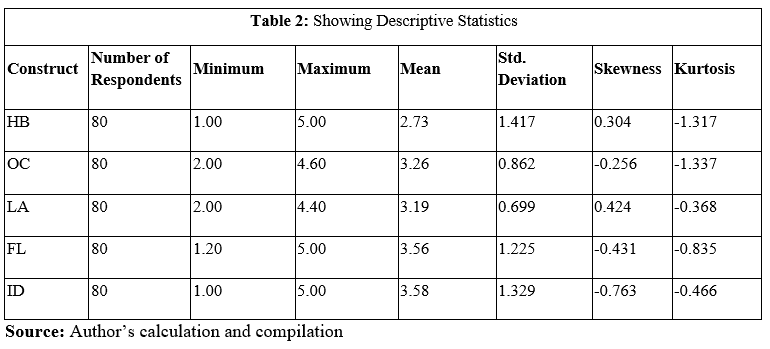
In this research article Descriptive statistics showed Investor’s moderate herding behavior, overconfidence, and loss aversion. Financial literacy and investment decisions are having higher mean values. Reliability tests confirmed all construct variables are consistent and dependable. Analysis of Correlation demonstrates that strong positive linkage in between financial literacy and investment decisions of retail investors. The probable aversion of losses has a negative relationship. ANOVA indicates significant differences in investment decisions across age groups. Age affects the influence of biases. Multiple regression identifies financial literacy as the strongest predictor. Loss aversion negatively influences investment decisions of investors. Collecting behavior of Investors’ and overconfidence are the contributing factors but not a noteworthy predictor. Multicollinearity tests indicated no biasness in variables. Test of Residuals confirms that there is no autocorrelation.
The study concludes that knowledge and awareness improve to predict trend in financial market investment decisions. The most important factors such as investors’ education and creating awareness. Stock market regulators can use these perspectives to frame market policies that reduce market volatility. Financial experts can provide guidance tailored to psychological tendencies.
Downloads
References
Das, R., & Das, S. (2025). Financial literacy as a moderator against overconfidence and herding. Journal of Academic Advancement, 4(1), 92–102.
Din, A., et al. (2025). Loss aversion and herding: The safety of the crowd in individual investment behavior. International Journal of Creative Research Thoughts, 13(5), 314–322.
Gupta, P., Sharma, R., & Verma, S. (2023). Influence of social media on herding behavior in investments. Journal of Informatics Education & Research, 3(2), 725–732.
Merikas, A., Georgiou, K., & Papadopoulos, T. (2024). Peer advice vs. press coverage in retail investment decisions. International Journal of Research & Analytical Reviews, 11(2), 119–125.
Mohd Adil, S. (2024). Socio-economic factors and financial literacy in investment decisions. Journal of Management Research & Analysis, 11(1), 160–168. https://doi.org/10.18231/2394-2770
Nair, V., & Antony, J. (2025). Overconfidence and selective information search in investor decision-making. Journal of Marketing & Social Research, 8(1), 40–55.
Published
How to Cite
Issue
Section
License
Copyright (c) 2026 Sandip Bhattacharyya

This work is licensed under a Creative Commons Attribution 4.0 International License.
Research Articles in 'Management Journal for Advanced Research' are Open Access articles published under the Creative Commons CC BY License Creative Commons Attribution 4.0 International License http://creativecommons.org/licenses/by/4.0/. This license allows you to share – copy and redistribute the material in any medium or format. Adapt – remix, transform, and build upon the material for any purpose, even commercially.


