Union Budget 2026 as a Catalyst for Viksit Bharat 2047: A Sectoral Based Evaluation
DOI:
https://doi.org/10.54741/MJAR/6.1.2026.277Keywords:
union budget 2026, viksit bharat 2047, sectoral allocation, public finance, outcome-based budgetingAbstract
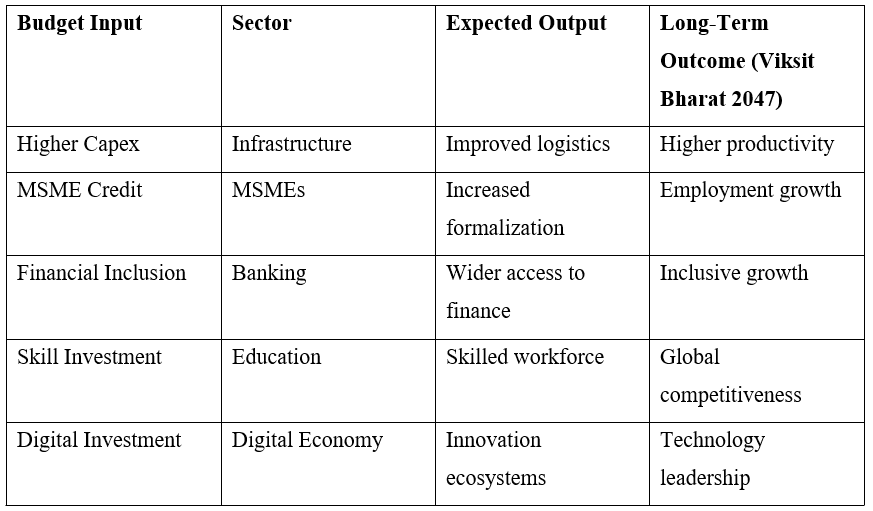
The Union Budget is the most important fiscal policy tool used by the Indian government each year to convert its long-term economic goals into workable plans. Given its positioning as a link between the country's aspiration to achieve Viksit Bharat 2047 and current fiscal challenges, the Union Budget 2026 assumes particular significance. A thorough sectoral and outcome-based analysis of the Union Budget 2026 is conducted in this paper from the standpoint of financial and commercial policy. The study compares Budget 2026 with Budget 2024–2025 using secondary data from Union Budget documents, Economic Surveys, and official government publications to evaluate shifts in sectoral priorities, capital expenditure trends, and reform orientation. Important industries are thoroughly examined, including MSMEs, banking and financial services, education and skill development, healthcare, infrastructure, agriculture, and the digital economy. An outcome-mapping framework is applied to examine how budgetary allocations are expected to influence investment, productivity, employment, financial inclusion, and long-term economic resilience. The findings indicate that Budget 2026 emphasizes investment-led growth, financial sector strengthening, and digital transformation, thereby aligning closely with the objectives of Viksit Bharat 2047. However, the paper also highlights implementation challenges, fiscal constraints, and the need for stronger monitoring mechanisms. In addition to providing policy recommendations for improving budget effectiveness, the study adds to the body of knowledge in public finance and commerce by establishing a connection between annual budgeting and long-term developmental outcomes.
Downloads
References
Government of India. (2024). Union Budget 2024–25. Ministry of Finance.
Government of India. (2026). Union Budget 2026. Ministry of Finance.
Musgrave, R. A., & Musgrave, P. B. (1989). Public finance in theory and practice. McGraw-Hill.
Stiglitz, J. E. (2019). Economics of the public sector. W. W. Norton & Company.
Published
How to Cite
Issue
Section
License
Copyright (c) 2026 Rajesh Kumar Vishwakarma, Anugya Singh

This work is licensed under a Creative Commons Attribution 4.0 International License.
Research Articles in 'Management Journal for Advanced Research' are Open Access articles published under the Creative Commons CC BY License Creative Commons Attribution 4.0 International License http://creativecommons.org/licenses/by/4.0/. This license allows you to share – copy and redistribute the material in any medium or format. Adapt – remix, transform, and build upon the material for any purpose, even commercially.


