Smart Factory Context and Employee Engagement in the Apparel Industry: A Systematic Literature Review
DOI:
https://doi.org/10.54741/MJAR/6.1.2026.275Keywords:
apparel industry, employee engagement, literature review, smart factory contextAbstract
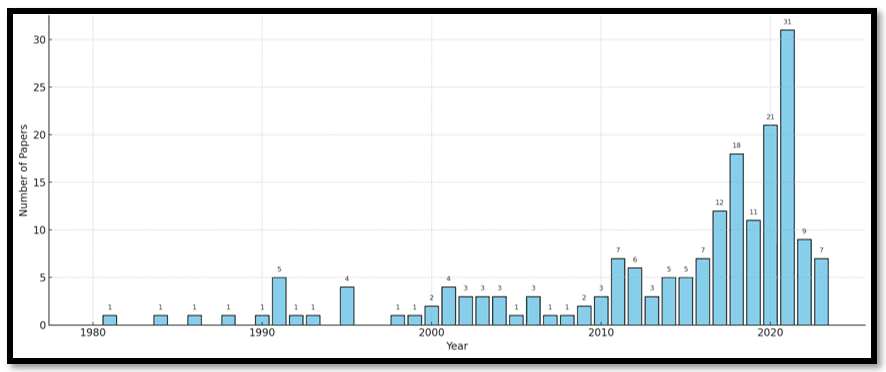
This study presents a systematic literature review on the correlation between the Smart Factory context and employee engagement in the apparel industry. Drawing on peer-reviewed journal articles, conference papers, and industry reports published from 1980 to 2024, the review synthesizes theoretical and empirical evidence from global and Sri Lankan manufacturing contexts, especially apparel industry. The findings indicate that while smart factory technologies such as automation, IoT, real-time data analytics, and system integration significantly enhance operational performance, their impact on employee engagement is largely contingent upon human-centric aspects. Adequate training and supportive work environments enable machine operators to adapt to technological change, thereby fostering emotional, cognitive, behavioral, and social engagement. The review further highlights that operational efficiency strengthens this relationship by reinforcing positive perceptions of technology adoption. The study contributes by integrating technological and human perspectives within the Smart Factory literature and by identifying critical pathways through which digital transformation influences employee engagement in the apparel industry.
Downloads
References
Acemoglu, D., & Restrepo, P. (2020). Robots and jobs: Evidence from US labor markets. Journal of Political Economy, 128(6), 2188–2244.
Ahmad, M. Khan, S. Khan, M.M., & Khan, F. (2022). Impact of supportive work environment on employee engagement in technology-driven organizations. International Journal of Human Resource Management, 33(14), 2875–2898.
Albrecht, S.L. (2012). The influence of job, team and organizational level resources on employee well-being, engagement, commitment and extra-role performance: Test of a model. International Journal of Manpower, 33(7), 840–853.
Albrecht, S.L. Bakker, A.B. Gruman, J.A. Macey, W.H., & Saks, A.M. (2015). Employee engagement, human resource management practices and competitive advantage: An integrated approach. Journal of Organizational Effectiveness: People and Performance, 2(1), 7–35.
Anitha, J. (2014). Determinants of employee engagement and their impact on employee performance. International Journal of Productivity and Performance Management, 63(3), 308–323.
Bailey, C. Madden, A. Alfes, K., & Fletcher, L. (2017). The meaning, antecedents and outcomes of employee engagement: A narrative synthesis. International Journal of Management Reviews, 19(1), 31–53.
Bain & Company. (2023). Industry 4.0 and smart manufacturing: Creating value through digital transformation. Bain & Company.
Bandara, W.M.K. Perera, T.D., & Silva, D.H.P. (2023). Organizational readiness for Industry 4.0 adoption in Sri Lankan manufacturing firms. South Asian Journal of Management, 30(2), 45–63.
Bessen, J.E. (2019). AI and jobs: The role of demand. Boston University School of Law, Law and Economics Research Paper No. 17-09.
CPS HR Consulting. (2023). Workforce readiness and training strategies for Industry 4.0. CPS HR Consulting.
Crawford, E.R., Rich, B.L. Buckman, B., & Bergeron, J. (2019). Examining the role of work engagement in the job demands–resources model. Journal of Applied Psychology, 104(3), 1–17.
Ghobakhloo, M. (2018). The future of manufacturing industry: A strategic roadmap toward Industry 4.0. Journal of Manufacturing Technology Management, 29(6), 910–936.
Ghobakhloo, M. (2020). Industry 4.0, digitization, and opportunities for sustainability. Journal of Cleaner Production, 252, 119869.
Harter, J.K. Schmidt, F.L., & Hayes, T.L. (2002). Business-unit-level relationship between employee satisfaction, employee engagement, and business outcomes: A meta-analysis. Journal of Applied Psychology, 87(2), 268–279.
Hofmann, E., & Rusch, M. (2017). Industry 4.0 and the current status as well as future prospects on logistics. Computers in Industry, 89, 23–34.
Jayasinghe, D., & Thavakumar, D. (2020). Operational efficiency and technology-enabled performance in apparel manufacturing firms. International Journal of Productivity and Performance Management, 69(7), 1501–1518.
Jayatilake, H., & Withanaarachchi, A. (2021). Industry 4.0 readiness assessment for apparel industry: A study in the Sri Lankan context. ResearchGate.
Jayatilake, L.V.K., & Rupasinghe, T.D. (2016). Technological innovation and workforce preparedness in Sri Lankan manufacturing organizations. Sri Lanka Journal of Management, 21(1), 1–18.
Jayawardana, A.K.L., & Weerasinghe, T.D. (2021). Digitalization and smart manufacturing practices in large-scale apparel firms in Sri Lanka. Journal of Textile and Apparel, Technology and Management, 12(2), 1–15.
Joarder, M.H.R., Sharif, M.Y., & Ahmed, K. (2017). Mediating role of affective commitment in HRM practices and turnover intention relationship: A study in a developing context. Business: Theory and Practice, 18, 218–231.
Kagermann, H. (2011). Industrie 4.0: Mit dem Internet der Dinge auf dem Weg zur 4. industriellen Revolution. VDI Nachrichten, 13, 2–3.
Kagermann, H. Wahlster, W., & Helbig, J. (2013). Recommendations for implementing the strategic initiative INDUSTRIE 4.0: Securing the future of German manufacturing industry. Frankfurt: Acatech – National Academy of Science and Engineering.
Kahn, W.A. (1990). Psychological conditions of personal engagement and disengagement at work. Academy of Management Journal, 33(4), pp. 692–724.
Kelegama, S. (2009). Ready-made garment exports from Sri Lanka. Journal of Contemporary Asia, 39(4), 579–596.
Khan, S. Anwar, S. and Ahmad, J. (2022). Work environment, employee commitment and performance: Evidence from manufacturing organizations. Journal of Organizational Effectiveness: People and Performance, 9(3), 410–428.
Kusiak, A. (2018). Smart manufacturing. International Journal of Production Research, 56(1–2), 508–517.
Lee, J., Bagheri, B., & Kao, H.A. (2015). A cyber–physical systems architecture for Industry 4.0-based manufacturing systems. Manufacturing Letters, 3, 18–23.
Macey, W.H., & Schneider, B. (2008). The meaning of employee engagement. Industrial and Organizational Psychology, 1(1), 3–30.
Maddugoda, L.A. (2021). Digital transformation and Industry 4.0 readiness of the Sri Lankan apparel industry. Journal of Textile and Apparel, Technology and Management, 12(3), 1–14.
Moher, D. Liberati, A. Tetzlaff, J., & Altman, D.G. (2009). Preferred reporting items for systematic reviews and meta-analyses: The PRISMA statement. PLOS Medicine, 6(7), e1000097.
Perera, R., & Jayasinghe, P. (2021). Managing workforce adaptation to smart manufacturing: Evidence from Sri Lanka’s apparel sector. Sri Lanka Journal of Management, 26(1), 23–41.
PM World Journal. (2023). Employee engagement in Industry 4.0 environments. PM World Journal, 12(4), 1–10.
Raj, A., & Kulkarni, V. (2020), Enabling smart factories through IoT and AI technologies: A review. International Journal of Productivity and Performance Management, 69(8), 1699–1723.
Rich, B.L. Lepine, J.A., & Crawford, E.R. (2010). Job engagement: Antecedents and effects on job performance. Academy of Management Journal, 53(3), 617–635.
Robertson, I.T., & Cooper, C.L. (2021). Wellbeing: Productivity and happiness at work. (2nd ed.). London: Palgrave Macmillan.
Robinson, D. Perryman, S., & Hayday, S. (2004). The drivers of employee engagement. Brighton: Institute for Employment Studies.
Saks, A.M. (2006). Antecedents and consequences of employee engagement. Journal of Managerial Psychology, 21(7), 600–619.
Schaufeli, W.B., & Bakker, A.B. (2004). Job demands, job resources, and their relationship with burnout and engagement: A multi-sample study. Journal of Organizational Behavior, 25(3), 293–315.
Schaufeli, W.B. Salanova, M. Gonzalez-Roma, V., & Bakker, A.B. (2002). The measurement of engagement and burnout: A two-sample confirmatory factor analytic approach. Journal of Happiness Studies, 3(1), 71–92.
Schumacher, A. Erol, S., & Sihn, W. (2016). A maturity model for assessing Industry 4.0 readiness and maturity of manufacturing enterprises. Procedia CIRP, 52, pp. 161–166.
Shuck, B. (2011). Four emerging perspectives of employee engagement: An integrative literature review. Human Resource Development Review, 10(3), 304–328.
Shuck, B., & Wollard, K. (2010). Employee engagement and HRD: A seminal review of the foundations. Human Resource Development Review, 9(1), 89–110.
Silva, D., & Wanninayake, W.M.C.B. (2021). The impact of employee engagement on sewing automation success in apparel manufacturing in Sri Lanka. Sri Lanka Journal of Management Studies, 3(1), 45–63.
Sony, M., & Naik, S. (2020). Critical factors for the successful implementation of Industry 4.0. Production Planning & Control, 31(10), 799–815.
Sony, M., & Mekoth, N. (2022). Employee engagement in the Industry 4.0 era: A systematic review. Benchmarking: An International Journal, 29(6), 1961–1989.
Tranfield, D. Denyer, D., & Smart, P. (2003). Towards a methodology for developing evidence-informed management knowledge by means of systematic review. British Journal of Management, 14(3), 207–222.
Wang, J. Xu, C. Zhang, J., & Zhong, R.Y. (2021). Big data analytics for intelligent manufacturing systems: A review. Journal of Manufacturing Systems, 58, 424–436.
Wickramasinghe, V., & Perera, S. (2021). Technology adoption and operational performance in the Sri Lankan apparel industry. South Asian Journal of Human Resources Management, 8(2), 210–228.
Wijayasiri, J., & Dissanayake, D. (2022). Digital transformation in Sri Lanka’s apparel industry. South Asian Journal of Management, 29(2), 89–108.
Wijethunga, H.G.S. Fernando, P.L., & Kumara, K.D. (2023). Smart factory adoption and competitive advantage in Sri Lanka’s apparel industry. Journal of Manufacturing Technology Management, 34(5), 987–1004.
Wijewardena, J., & Siriwardana, A. (2020). Employee engagement and organizational performance: Evidence from manufacturing firms in Sri Lanka. Asian Journal of Management Studies, 7(2), 89–105.
Xu, L.D. Xu, E.L., & Li, L. (2018). Industry 4.0: State of the art and future trends. International Journal of Production Research, 56(8), 2941–2962.
Yapa, S. G. Perera, G. D. N., & Jayasekara, P. (2025). Employee engagement in smart factories: Research gaps and a nomological framework for the Sri Lankan apparel sector. International Journal of Research and Innovation in Social Science, 9(9), 4538–4549.
Zhong, R.Y. Xu, X. Klotz, E., & Newman, S.T. (2017). Intelligent manufacturing in the context of Industry 4.0: A review. Engineering, 3(5), 616–630.
Published
How to Cite
Issue
Section
License
Copyright (c) 2026 S G Yapa, G D N Perera, P Jayasekara

This work is licensed under a Creative Commons Attribution 4.0 International License.
Research Articles in 'Management Journal for Advanced Research' are Open Access articles published under the Creative Commons CC BY License Creative Commons Attribution 4.0 International License http://creativecommons.org/licenses/by/4.0/. This license allows you to share – copy and redistribute the material in any medium or format. Adapt – remix, transform, and build upon the material for any purpose, even commercially.


