Economic Sustainability and Creative Freedom among Youth in India: An Analytical Study
DOI:
https://doi.org/10.5281/zenodo.17745775Keywords:
creative economy, cultural economics, financial sustainability, youth and arts, creative labour market, income instability, financial literacy, artistic autonomy, institutional support, societal pressureAbstract
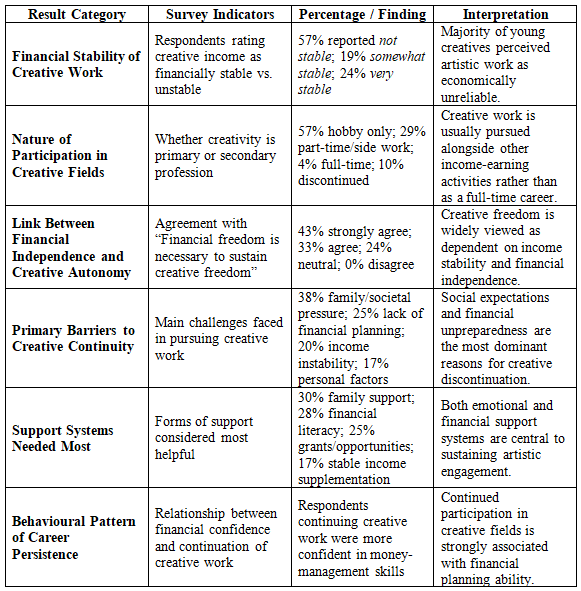
The dynamic between creative expression and financial survival is gaining heightened salience for young people trying to forge professional identities in artistic fields. While creative work is considered to be emotionally nourishing, it is difficult for most people to sustain long-term engagement in the arts without reliable streams of income, conducive environments, and a pragmatic understanding of money management. This paper explores the various ways in which youth in India negotiate the troubling friction between creative ambition and economic imperatives. Drawing from previously existing scholarly work and survey responses of over one hundred youths engaged in a variety of creative practices, the study analyses the impact of financial literacy, family expectations, personal motivation, and institutional support in determining creative careers. It concludes that artistic freedom is not sacrificed at the altar of financial planning; instead, creativity thrives when people have the economic means and social support to do what they love.
Downloads
References
Bakhshi, H., & Cunningham, S. (2016). Cultural policy in the time of the creative industries. British Journal of Management, 17(S1), S1–S8.
Banks, M. (2017). Creative justice: Cultural industries, work and inequality. Rowman & Littlefield.
Florida, R. (2012). The rise of the creative class. Basic Books.
Hesmondhalgh, D., & Baker, S. (2011). Creative labour: Media work in three cultural industries. Routledge.
Oakley, K., & O’Brien, D. (2016). Learning to labour unequally: Understanding the relationship between cultural production, cultural consumption and inequality. Social Identities, 22(5), 471–486.
Throsby, D. (2010). The economics of cultural policy. Cambridge University Press.
Towse, R. (2019). A textbook of cultural economics. (3rd ed.). Cambridge University Press.
Published
How to Cite
Issue
Section
License
Copyright (c) 2025 Dev Shah, Deshna Sancheti, Sugam J. Shivhare, Abhijeet Dawle

This work is licensed under a Creative Commons Attribution 4.0 International License.
Research Articles in 'Management Journal for Advanced Research' are Open Access articles published under the Creative Commons CC BY License Creative Commons Attribution 4.0 International License http://creativecommons.org/licenses/by/4.0/. This license allows you to share – copy and redistribute the material in any medium or format. Adapt – remix, transform, and build upon the material for any purpose, even commercially.


